فرتیلی بہترین پریکٹس: وہ جملہ جو گیم کو دور کرتا ہے۔
Someone wrote “Agile best practice” in a message thread recently. Three words. Confident. Unremarkable to everyone else in the thread.
I read it. I did not reply.
Not because I had nothing to say. It was review day. There was a customer waiting, and the choice was simple: spend energy correcting the vocabulary of a colleague, or spend it on what actually mattered.
I chose the customer.
That choice, prioritising outcomes over orthodoxy, delivery over debate, is agile best practice. The real kind. The kind that does not announce itself.
Which makes the irony of the original phrase rather beautiful.
Agile best practices: the oxymoron hiding in plain sight
“Best practice” is a specific kind of claim. It asserts that a proven, transferable answer exists: something that worked somewhere, for someone, and therefore ought to be adopted universally.
It is, in essence, the argument for copying.
Now read the Agile Manifesto’s four values:
- Individuals and interactions over processes and tools
- Working software over comprehensive documentation
- Customer collaboration over contract negotiation
- Responding to change over following a plan
Every one of those values is a statement of context over prescription. A preference for the living, adaptive, human response over the fixed, documented, transferable answer.
The Manifesto’s authors, people who had spent careers watching methodology become a cage, did not write a manual. They wrote a manifesto. Deliberately. Because the moment you codify the answer, you kill the question. And it is the question, what works here, for us, now?, that is the entire engine.
“Best practice” does not just miss that point. It contradicts it.
What the data says about agile best practices
If the philosophical case feels abstract, the 18th State of Agile Report (Digital.ai, 2025) offers one number worth sitting with.
74% of respondents now use hybrid, blended or homegrown Agile models, according to Digital.ai’s own release. Nearly three-quarters. Read that as adaptation, not abandonment: Scrum.org’s summary puts SAFe use at 44% over the same period, and SAFe often sits inside a hybrid.
One caution about the source. The survey had nearly 350 participants, primarily Agile coaches and consultants from large enterprises. That is the circus reviewing itself. Even in that room, most say they have gone hybrid, blended or homegrown.
The same report, as summarised by Scrum.org, adds two more figures: 63% report declining software quality, and only 13% say Agile is fully embedded across their business.
Read together, that is what you would expect when an answer is imported rather than earned. Heavy adaptation. Thin embedding. Quality slipping.
Dave Witkin of Packaged Agile names the pattern: Delivery Theatre: the mistaken belief that Agile methods without the right people, support, and context could deliver significant, lasting value. Performing the vocabulary. Skipping the thinking.
That is what agile best practices culture produces at scale. Not agility. Infrastructure dressed as agility.
The complexity tax, applied to thought
In an earlier piece on the Agile Circus, I wrote about the Complexity Tax: the waste generated when simple conversations get buried under elaborate frameworks and theatrical process.
“Best practice” is the Complexity Tax applied not to meetings but to thought.
It takes a genuinely difficult, contextual question: what should we do here, given who we are, what we know, and what we are trying to achieve? And replaces it with a shortcut. A pre-packaged answer. A way of appearing to think without actually doing it.
The cost is not the phrase itself. The cost is what the phrase prevents: the honest, uncomfortable, necessary conversation about whether what you are doing is actually working.
That conversation is the heart of Agile. “Best practice” is how you avoid having it.
A gentler reading
The people who say “Agile best practice” are almost never acting in bad faith. In my experience they are often the most enthusiastic in the room, the ones who have done the certifications, read the frameworks, committed to the vocabulary.
That is exactly where the circus gets you.
As I explored in Part 2 of this series, the most seductive act in the Agile circus is not cynicism. It is compliance dressed as conviction. Knowing the language so well you mistake it for the thing itself.
The tell is not ignorance. The tell is certainty. Genuine Agile practitioners are uncomfortable with universal answers. They ask too many questions. They say “it depends” and mean it. They are suspicious of anyone, including themselves, who sounds too confident about what the right approach is.
The 18th report is consistent with this: most respondents now run something adapted to their context. Not best practice. Best fit.
The framing matters enormously. Practitioners who have moved past the circus tend to reach for something closer to:
“This has worked in similar contexts: worth examining whether it fits ours.”
“Here is a pattern others have found useful: what would need to be true for it to work here?”
“This is what the data suggests: let us test it against our situation.”
The difference is not pedantic. It is the difference between importing an answer and earning one. Between compliance and capability. Between the circus and the garden.
We are about to do this again
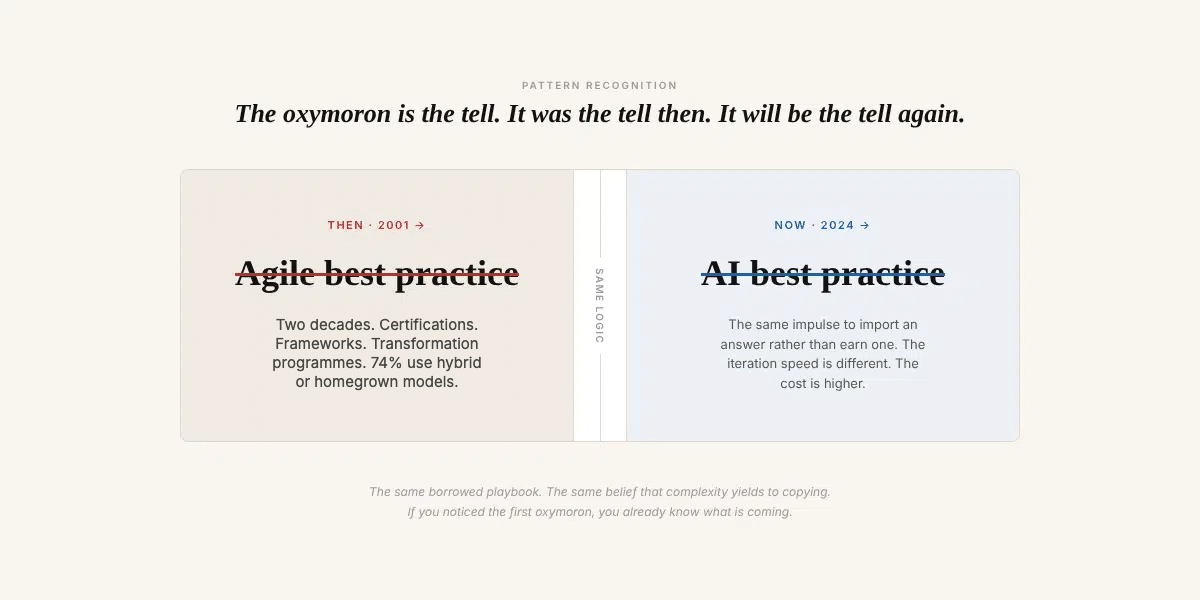
The phrase will be different. The logic will be identical.
Somewhere in your organisation, someone has already written “AI best practice” in a message thread. Confident. Unremarkable to everyone else in the room.
Two words borrowed from the same borrowed playbook. The same impulse to import an answer rather than earn one. The same belief that complexity yields to copying.
The Agile experiment ran for two decades before 74% of respondents were using hybrid, blended or homegrown models. AI will not get two decades. The iteration speed is different. The cost of theatrical compliance is higher.
Process theatre took years to show up in the numbers. A model’s assumptions are in every output from day one. There is no hiding period.
If you have spent any time thinking about what went wrong with Agile, you already know what is coming.
The oxymoron is the tell. It was the tell then. It will be the tell again.
An invitation, not a verdict
The quiet revolution I wrote about in Part 3 is not made up of people who have never been inside the tent. It is made up of people who walked out.
If you have said “Agile best practice” at some point in your career, I have too. That is not the point. The point is what happens the next time you reach for the phrase.
Do you say it? Or do you pause, and ask the harder question?
If you would like to compare notes, I am easy to find over a virtual chai.
Thank you for reading. If you are new here, I’m Kubair Shirazee, I help people, teams, organisations and communities navigate past the status quo and find better ways of collaborating and delivering impact. This post is part of an ongoing series on authentic agility. Start with Part 1, continue with Part 2, and read the earlier data analysis in Part 3. Figures in this post are from the 18th State of Agile Report (Digital.ai, 2025), as reported in its press release اور Scrum.org’s summary.