Eisenhower Matrix vs Topic Triage Matrix
In April 2026 I asked a large pharmaceutical company’s marketing operations chapter to write their real prioritisation conflicts on cards, one each and anonymously, and to stick each card under the heading that fitted best.
Six went under “Urgency Override”: something louder jumps the queue, regardless of actual priority or agreed commitments. No heading on the wall had more.
One card described a review squeezed into under five days because an agency had run late, and a reviewer annoyed at being pushed. Another, from the second session, described a request for tasks and timelines that was ignored “because the request was urgent”, with the work handed to an outside supplier to hit the date, at a cost to the team’s own way of working.
I had seen the same pattern in their planning boards before the workshop. One team had nothing marked medium priority at all: everything was high, or untagged. They had no shared language for important but not urgent, which is the gap the Eisenhower matrix was drawn to name. The Topic Triage Matrix does a similar job for the team’s meetings.
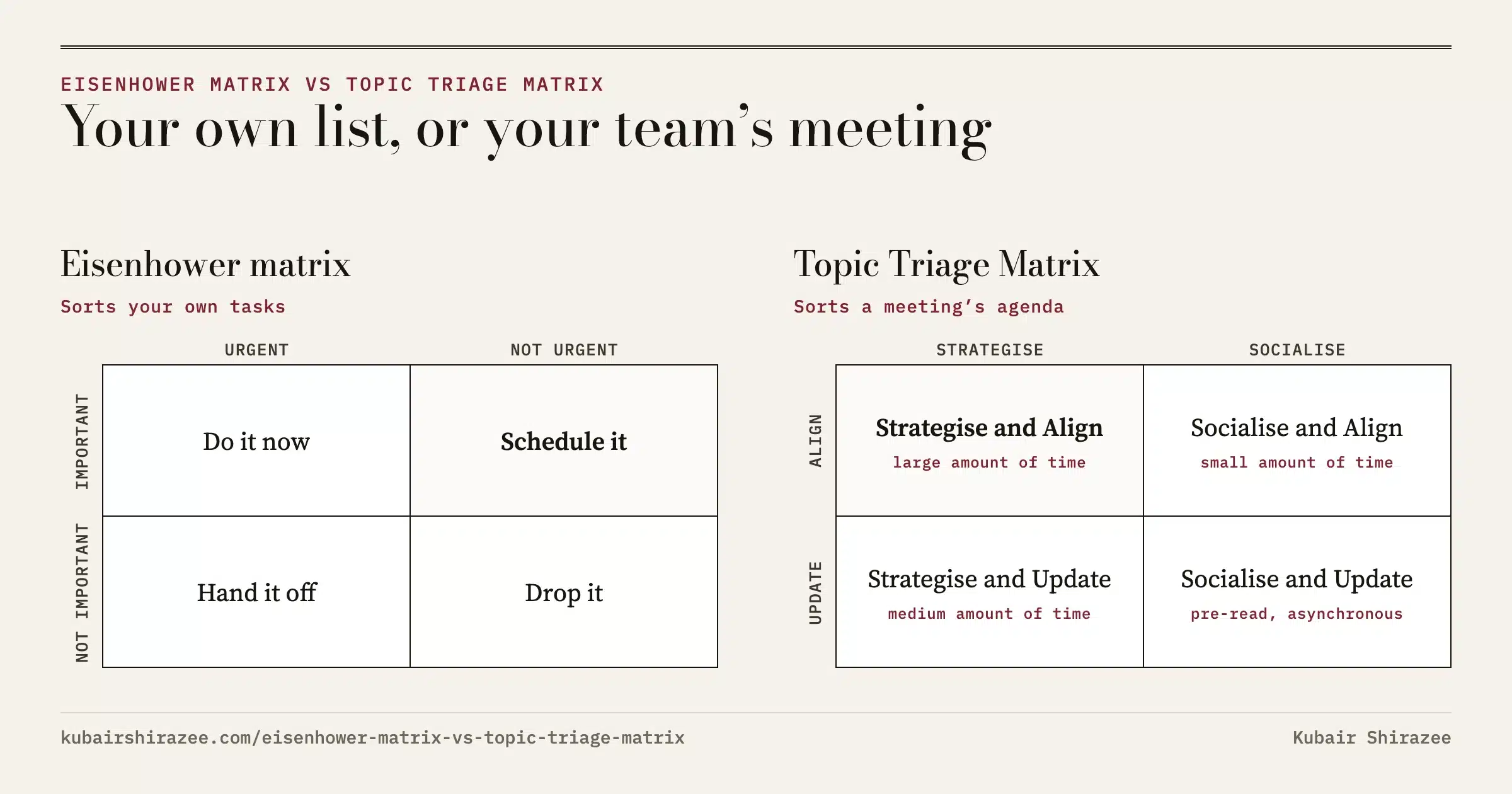
Both are two-by-two grids for deciding where attention goes. The Eisenhower matrix sorts your own tasks by urgency and importance, and tells you what to do now, schedule, hand off or drop. The موضوعات کی ترجیحی میٹرکس sorts a meeting’s agenda by the kind of thinking each item needs and whether it needs the room’s agreement, and tells you which items deserve shared time.
What is the Eisenhower matrix?
A grid with urgency on one axis and importance on the other. It takes its name from US President Dwight D. Eisenhower, who in a 1954 speech credited the line about urgent and important problems to an unnamed former college president, and it was popularised by Stephen Covey as the time management matrix in The 7 Habits of Highly Effective People.
- Urgent and important: do it now.
- Important, not urgent: schedule it. This is where most valuable work sits, and the quadrant that gets squeezed first.
- Urgent, not important: hand it to someone else, or answer it briefly.
- Neither: drop it.
ٹاپک ٹریاج میٹرکس کیا ہے؟
A grid I use to decide, before a meeting, which agenda items deserve the room. It asks two questions of each item: does it need strategic thinking or just information sharing, and does it need the room’s alignment or is it an update?
- Socialise and Update: information sharing. Move some of it to a pre-read or a message.
- Socialise and Align: collaborative items that need agreement.
- Strategise and Align: complex, collaborative decisions. This is where the room earns its time.
- Strategise and Update: strategic information sharing, such as a sprint review demonstration.
The matrix template and facilitator’s guide are free on the Topic Triage Matrix page.
Eisenhower matrix vs Topic Triage Matrix
| Eisenhower matrix | موضوعات کی ترجیحی میٹرکس | |
|---|---|---|
| What you sort | Your own tasks | Items on a meeting agenda |
| The two questions | Is it urgent? Is it important? | Strategic or information sharing? Alignment or update? |
| Who uses it | One person | The person running the meeting, with the team |
| What it decides | Do, schedule, hand off or drop | Room time, a short slot, or a message |
| What to watch for | Everything starts to look urgent | Topics labelled “strategic” only to win meeting time |
When to use which
- Your inbox and to-do list are full and you cannot see what matters: the Eisenhower matrix.
- A recurring meeting keeps overrunning, or people sit through updates they could have read: the Topic Triage Matrix.
- A decision keeps coming back to the same meeting: neither. That is usually a question of who is allowed to decide.
The catch with urgency
Urgency is the criterion most organisations already use, whether they admit it or not, because the system rewards it. A grid can show you that; it cannot fix it on its own. I wrote about that in the criterion you’re already using, the first part of the prioritisation series.
عام سوالات
Who invented the Eisenhower matrix?
It is named after Dwight D. Eisenhower, who is often quoted on the difference between urgent and important. Stephen Covey turned the idea into the four-quadrant grid most people use today.
Can a team use the Eisenhower matrix?
It is built for one person’s workload. For a team, agree shared criteria from real trade-offs instead; the prioritisation series shows how.
Is the Topic Triage Matrix free?
Yes. The template and the facilitator’s guide are free PDFs on the Topic Triage Matrix page.
The chapter did not try to abolish urgency. When the room wrote its own prioritisation criteria that afternoon, it kept a lane called “Most urgent”, with one condition: even the most urgent item had to say what it depended on. A few weeks later, one team’s agreed action was to go through its backlog from the top against the criteria it had written, and push anything that did not meet them below the line. Below the line is where important but not urgent work finally gets a name and a place to wait, rather than being drowned out by whatever is loudest that week.
Use the Eisenhower matrix on your own list and the Topic Triage Matrix on your team’s meetings. And when the same urgent item keeps jumping the queue, it has stopped being a prioritisation problem: it is a question of who is allowed to decide, which is the work I do with organisations.
Where to go next
- Triage your next agenda: download the matrix and the facilitator’s guide on the Topic Triage Matrix page.
- If decisions are slow to land, read about فیصلے کی تاخیر.
- Another pair that get confused: مکمل کی تعریف بمقابلہ تیار کی تعریف.
If urgency keeps overriding your priorities and you would like a second view, میرے کیلنڈر پر 20 منٹ حاصل کریں۔ and we can compare notes over a virtual cuppa.
آخری بار جائزہ لیا گیا: نومبر 2026۔