Definition of Done vs Definition of Ready
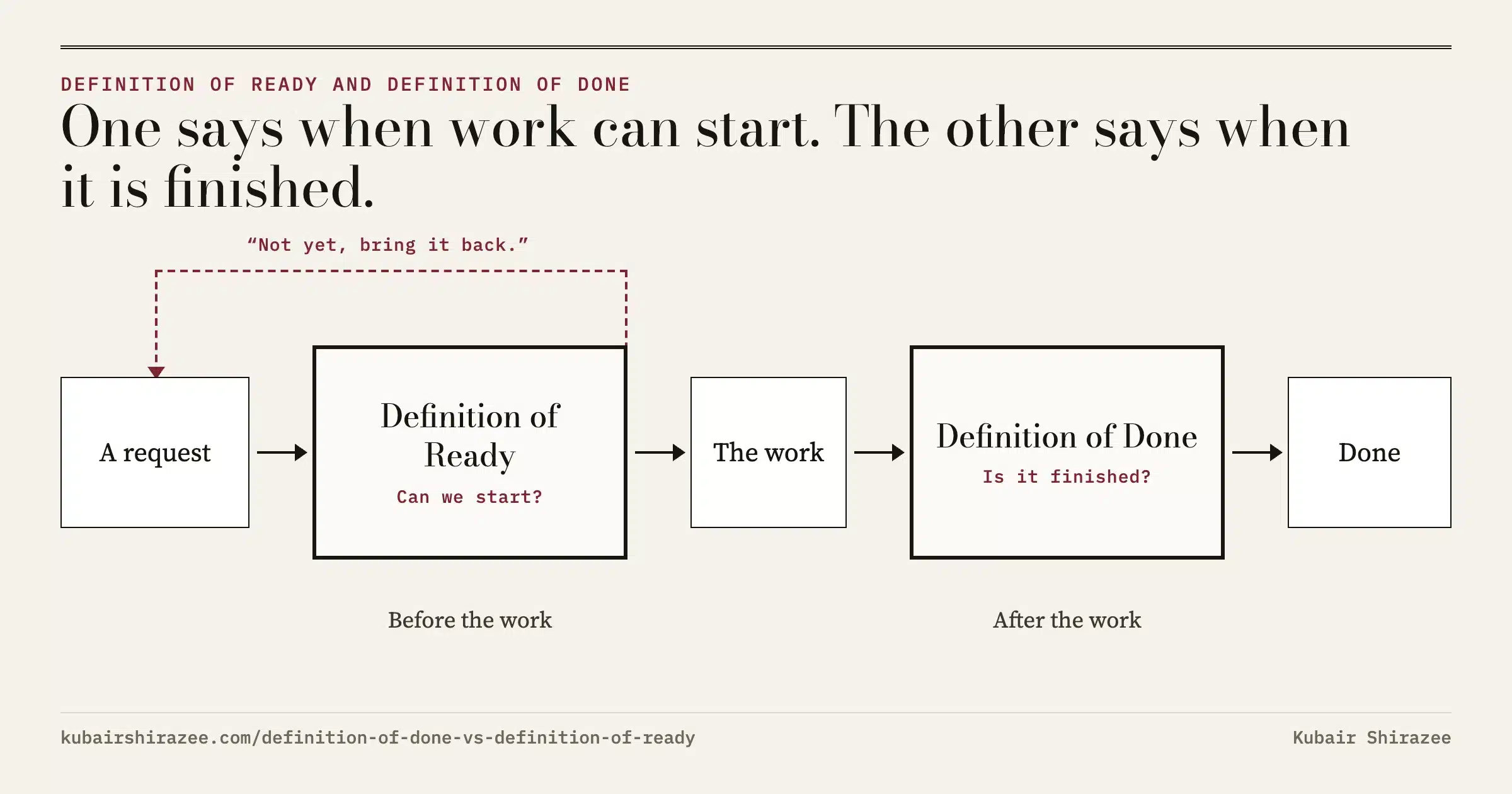
“Not yet, bring it back.” In 2026 that was the standard reply, in a large pharmaceutical company’s marketing operations chapter, to any request that reached a sprint without answers to five questions: why it mattered, who owned it, whether it was worth the cost of delay, what the real deadline was, and what would be dropped to make room for it. It sounds like a door closing. In practice it opened one, because the conversation that would otherwise have surfaced halfway through the sprint now happened with the product owner before anyone started the work.
That is the job of a Definition of Ready. Its partner, the Definition of Done, does the same job at the other end of the work.
The Definition of Done is the team’s shared checklist for when a piece of work is finished: built, checked and usable, with nothing left that someone has to come back for. The Definition of Ready is the checklist for when a piece of work is clear enough to start. One protects what leaves the team, the other protects what comes in.
Both are short lists the team writes together and applies to every item, so they settle the same argument once rather than story by story.
What is a Definition of Done?
In the Scrum Guide, the Definition of Done describes the quality an increment has to meet before it counts as done. Work that does not meet it is not released and is not shown at the sprint review; it goes back to the product backlog. If the organisation has its own standard, the team uses that as the minimum. If it has none, the team writes one.
It is not the same as acceptance criteria. Acceptance criteria belong to one user story and say what that story must do. The Definition of Done applies to every item and says how well it must be done.
What is a Definition of Ready?
The Definition of Ready lists what has to be true before a story is pulled into a sprint. It is a team practice, not part of the Scrum Guide. Acceptance criteria are usually the first line on it: a story without them is not ready for estimation or technical breakdown. No acceptance criteria, no “ready”.
Its real value is the conversation it forces. Used well, a Definition of Ready is how a team asks the hard questions before work starts rather than halfway through a sprint: why this, why now, who owns it, and what we stop to make room for it. Used as a checklist or a gate, it turns into paperwork that people learn to tick through.
A Definition of Ready in practice
I worked with that chapter in 2026 on how their work gets prioritised. Their Definition of Ready was five questions, and every one had to be answered before an item could enter a sprint:
- What is the strategic reason? Which 90-day priority does it serve?
- Who is the named owner? A person, not a brand, who will brief, review and approve.
- Does the impact justify the cost of delay?
- Is there a hard date? If not, what is driving the urgency?
- What are we deferring to make room? “Nothing” means adding capacity we do not have.
Items that could not answer them got the reply you met at the top of this page. That kept half-formed requests out of the sprint, and it put the difficult conversations where they belong: with the product owners, before the work started.
The aim is a habit rather than a filter. Early on, the Definition of Ready catches a lot. As product owners and teams get used to having those conversations up front, fewer items arrive unready. The list starts to describe how the team already works instead of what it checks.
Definition of Done vs Definition of Ready
| Definition of Done | Definition of Ready | |
|---|---|---|
| Question it answers | Is this finished? | Is this clear enough to start? |
| When you use it | Before an item is called done, released or shown at review | Before an item is pulled into a sprint |
| Applies to | Every item, and the increment as a whole | Every item entering the sprint |
| In the Scrum Guide? | Yes, as the commitment for the increment | No, a common team practice |
| Main risk | Written once, never checked | Turns into a gate that blocks work |
Definition of Done examples
A starting point to edit, not a rule. Strike out anything your team cannot check every time, and add what keeps coming back to bite you.
- Reviewed by someone other than the person who built it
- Tests written and passing
- Acceptance criteria met and confirmed with the product owner
- Help text or documentation updated where users will notice the change
- Deployed to the environment the team agreed
- No known defects left open against the item
Definition of Ready examples
- Written as a user story with a clear who and why
- Acceptance criteria agreed (how to write them)
- Small enough to finish within one sprint
- Dependencies named, each with an owner
- Talked through by the team, who can estimate it
How to agree them with your team
- Start with what went wrong. Ask which items came back after being called done, and why. Those reasons are your first lines.
- Draft the shortest list the team will actually check. Five lines that are used beat fifteen that are not.
- Put both lists where the work is. On a board, the Done column means “meets the definition of done” (see setting up a board in Microsoft Teams).
- Review them in the retrospective. Add a line when something slips through; remove one nobody has needed.
- Record them in your team agreement, so new joiners see them on day one.
Experiment, and keep what adds value
Treat both definitions as experiments. Try a line for a few sprints, ask in the retrospective whether it is helping, and drop it if it is not. Don’t be beholden to a method, tool or framework, including this one. What works depends on your context and the nature of your work. A marketing operations team and a software team will not need the same list.
Common mistakes
- Treating the Definition of Ready as a checklist to tick, so the conversations it was meant to force never happen.
- Copying another team’s list. The value is in the conversation that produces it.
- A Definition of Done nobody checks. If it is not used at review, it is decoration.
- Using the Definition of Ready as a gate to refuse work, instead of as a prompt to come back with answers.
Common questions
Is the Definition of Ready part of Scrum?
No. The Scrum Guide defines the Definition of Done but not a Definition of Ready. Many teams use one anyway, alongside refinement.
Should a Definition of Ready be a gate?
Use it to start the conversation, not to stop work. “Not yet, bring it back” asks the requester to return with answers. It is not a no.
Does a team always need a Definition of Ready?
Not necessarily for ever. Keep it for as long as it adds value, then review it.
Who owns the Definition of Done?
The Scrum Team. If the organisation sets a standard, that is the minimum and the team can add to it.
What is the difference between the Definition of Done and acceptance criteria?
Acceptance criteria are specific to one story. The Definition of Done applies to every story. A story is done when it meets both.
“Not yet, bring it back” was never meant to last for ever. In a team where the Definition of Ready is working, you hear it less as time goes on, because requests start arriving with the conversations needed to get started already had.
Most of those conversations belong in refinement, the regular session where the product owner and the team look at what is coming next. In the marketing operations chapter it was weekly, and work moved into a sprint through refinement rather than through urgency. Refinement goes faster when everyone asks the same questions in the same order, and one way to give it that shape is the What-Why-How-Done Canvas: what needs to change, why it matters, what done looks like, and only then how. When nobody needs to say “not yet” any more, the list has done its job, and you can decide whether it still earns its place.
To agree your team’s definitions together in the room, see my agile transformation workshops. If urgency keeps jumping the queue, see Eisenhower Matrix vs Topic Triage Matrix for two ways to sort it.
Last reviewed: November 2026.