AI does not create redundancies. It makes them visible.
A leading pharma company I worked with was short of capacity. Its answer was to bring in more external agencies.
It was not short of capacity. It was spending it.
Much of the talk about AI redundancies makes the same mistake.
Components built again for every digital asset instead of once for all of them. The same request sitting in several digital backlogs under different names. Websites that got almost no traffic, still being patched, still being paid for.
Nobody was hiding any of it. I know, because of a wall.
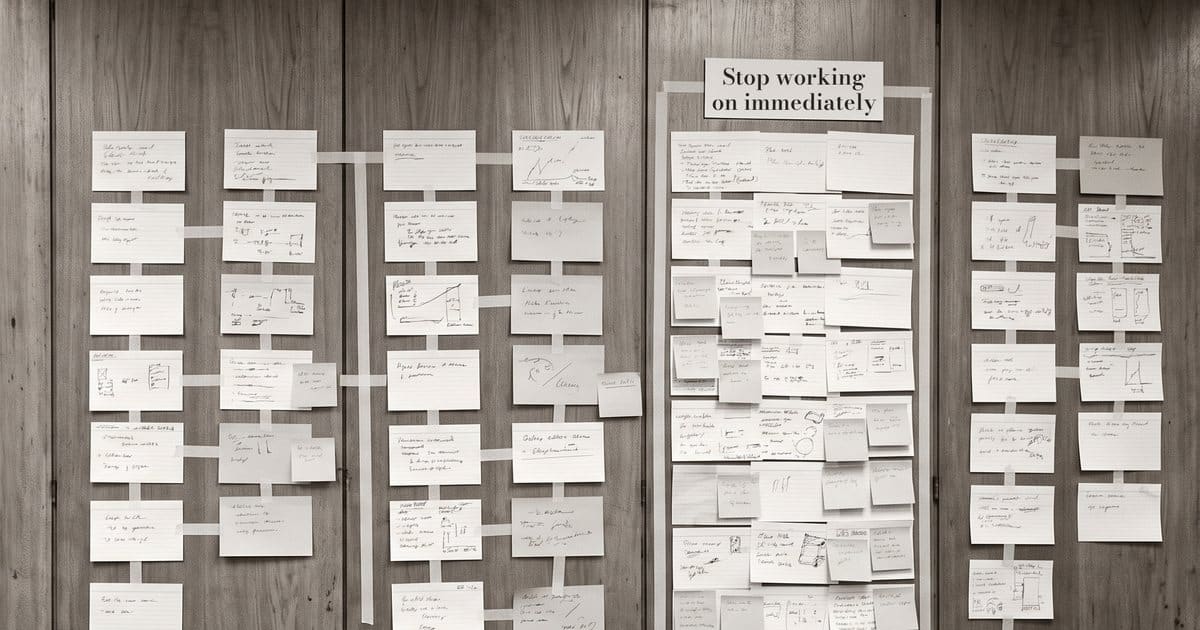
We turned an office into a war room for a week and built the portfolio on the wall: every digital asset and every backlog item on a card, in columns. One column was headed stop working on immediately.
The cards in that column were not ours. They were written by product owners and project managers from the team of a senior marketing leader. When she saw the wall, she was stunned.
The list was theirs. The wall only put it somewhere their leader could see it.
That is what makes redundancy so durable. It is spread so thinly across so many teams that nobody sees the total.
The same blind spot sits behind the AI redundancies debate.
I call it the capacity trap: adding capacity to a system that is already spending most of what it has on keeping things alive.
What do we mean by AI redundancies?
In English, redundancy means two things.
The first is surplus: duplicated work, overlapping tools, assets nobody uses. It belongs to the organisation. The second is a decision: someone is told their role is no longer needed. It belongs to whoever made the call.
AI touches the first. It never touches the second.
AI does not create the surplus. It puts the house lights on. I wrote in The Agile Circus is dead about how much of organisational life is performance. When the lights come up, the show has not changed. What has changed is that everyone can see the empty seats and the idle crew, and someone has to decide what to do about them.
What did we do with the capacity we found?
We did not hire. We looked.
I was the transformation lead for product governance there, so this is not a view from outside.
The portfolio view, which started as that wall, put every digital backlog in one picture for the first time. Duplicates stopped hiding behind different names.
Product owners were enabled to ditch work. That sounds small. It is not. A named person with the right to say “not this” is rare. In most organisations that right belongs to a committee, and a committee rarely says it. I wrote about this in Who can say yes, and does everyone know it?
“My budget” became shared resources. That was the hard one. Everything else could be done with process. This had to be done with people.
Sprint discipline kept the freed capacity from refilling with the next low-value request. And the external agencies were redeployed or scaled back instead of added to.
The numbers: about 30% of the backlog turned out to be redundant. Over two years the portfolio saved more than €4 million. Time to market in a regulated environment fell from 14 months to 3.
Removing the redundancy did not do all of that. It created the capacity. The operating changes protected it.
I should be honest about the cost as well. Some agencies were redeployed. Others were scaled back. Someone paid for that choice, and it was a choice.
Why does AI change the economics of seeing?
At the pharma company, seeing the redundancy took a wall, a great many conversations and a lot of patience. There was no AI involved.
That is the point. The mechanism behind AI redundancies is old. AI cuts the price of seeing it.
In AI Won’t Fix Your Organisation I argued that AI works as a diagnostic. Seeing has just got cheaper.
In a large London borough, where I led a digital, data and AI programme, a discovery cycle of nine to thirteen days, with AI industrialising the write-up under human supervision, produced the kind of end-to-end picture of a service that used to take months. The surplus did not get bigger. The excuse for not seeing it got smaller.
AI also creates some surplus of its own: reports nobody reads, tools bought twice, pilots that overlap. Count those too. They are new enough that nobody has yet built a career defending them.
What can a leader do once they can see it?
Four things.
Cut. Redeploy. Redesign. Or look away.
Looking away is a choice too. It is the one most often made and the one least often owned.
When a cut is announced as “because of AI”, ask who decided. Somebody did. The tool produced a picture. A person produced the decision.
At the pharma company the reflex was to add capacity. The reflex now is to remove it. Both skip the same question: what is the capacity being spent on?
And not everything that looks redundant is. Some of it is buffer. We could tell the difference because we looked at the traffic, not the org chart. Transparency shows you the surplus. It cannot tell you which part to keep. That judgement stays with the leader.
I have written before that decision latency is rarely about speed. The same applies to AI redundancies. AI will show you the surplus in days. How long you take to decide is still yours.
So here is my question
When AI shows you where your capacity is going, who in your organisation has the right to say “ditch it”?
And do they know?
If you would like to compare notes, I’m easy to find over a virtual chai.
Thank you for reading. If you’re new here, I’m Kubair Shirazee, I help people, teams, organisations and communities navigate past the status quo and explore better ways of collaborating and delivering impact.