The pilot worked. Nothing changed.
One team had starred eleven of its thirty-two backlog items as non-negotiable.
Earlier this year I ran a Decision System Tune-Up with the marketing operations chapter of a leading global pharmaceutical company. There was no AI in the room. Just the teams’ real quarterly backlogs, made visible side by side.
The question I put to that table was simple. If eleven things are non-negotiable, what do you actually have discretion over?
On another board, three items in the medical area were blocked. All three were waiting on approval decisions. My facilitator notes read: these are decision failures, not delivery failures. Who can unblock them, and are they in this room?
It is the question most AI business cases never ask.
Now put a model in front of that backlog. It will rank the work faster and more consistently than any planning meeting. Every ranked item will then wait for exactly the same approval it was waiting for before.
Most boards are now asking a version of one question. How does an enterprise move from AI ambition and isolated pilots to an AI operating model that delivers measurable economic value at scale?
That backlog holds most of the answer. The model is rarely the constraint. The constraint sits in the decisions around it: who is allowed to act on what the model says, and who answers for the number afterwards. And before a model ranks that backlog, ask how much of it should be there at all. AI makes that surplus visible in days. Who may say “ditch it” is still a decision.
Is this just one company?
No. The pattern shows up wherever anyone has looked.
MIT’s Project NANDA, in The GenAI Divide: State of AI in Business 2025, found that 95% of enterprise generative AI pilots showed no measurable P&L impact. The study is small, and critics point out that many of those pilots never measured where they started. That doesn’t weaken the finding. It explains it. A pilot that never measured its starting point can’t show a return, however well it works.
McKinsey’s 2025 State of AI survey, with 1,993 respondents, puts it more starkly. 88% of organisations use AI in at least one function. 39% report any EBIT impact at enterprise level. About 6% qualify as high performers, and what sets them apart is that they redesign workflows rather than bolting models onto the ones they have.
Adoption is close to universal. Value is rare.
What does a successful pilot actually prove?
A pilot is designed to succeed. That is the trouble with it.
It gets a hand-picked team, clean data, a sponsor’s full attention and a quiet exemption from the governance everyone else lives under. It is built for presence: the right people in the room, paying attention, willing to make the call.
Scale is the opposite condition. The sponsor has moved on. The team has been reabsorbed. The output lands with someone who was never in the pilot and was never told the decision was theirs. Scale is designing for absence, and a pilot never tests it.
At a London borough council I worked with this year, one of the AI tools we built, a complaints analyser, went into pilot with the officers who handle formal complaints. They used it. They wanted more of it. Writing it up afterwards, the most accurate line I could find was this one.
It found its users before it found a sponsor.
That is how most good AI work stalls. The tool works. Nobody has the authority to make it part of the day job. The result is a pilot shelf: a row of pilots that worked, parked, because nothing in the AI operating model changed to receive them.
Why does AI governance so often make it worse?
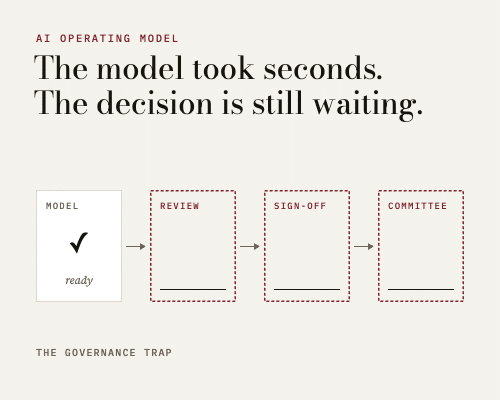
Go back to that pharma backlog. The instinct, once a model arrives, is to govern it: a review step for its recommendations, a sign-off before anything changes, a committee to oversee the lot.
This is the governance trap. Organisations build governance for AI recommendations that mirrors the governance that already slowed human ones. The agent problem gets solved. The organisation problem stays exactly where it was, now with an extra layer on top.
I’ve argued before that AI exposes the decision system rather than fixing it, in AI Won’t Fix Your Organisation. The approval step is where that exposure shows first.
If pilots don’t scale, what does?
Reuse.
By June, the council’s first-year AI portfolio was in front of its transformation steering group: seven business cases across nine use cases, about £1.6m in total. The spread inside it was the interesting part.
The cases that carried the build (the engineering, the data foundations, the common design) were costed at £176k to £500k. The cases that reused what those had built were costed at £15k to £25k.
The shared platform model behind those numbers was the council’s, and it predated me. My contribution was costing the portfolio on it, which made the economics visible to the people deciding where the money went.
The first use case pays for the platform. Every one after it is cheap.
A portfolio of pilots works the other way round. Each one is scoped to stand alone, so each one pays full price, and the tenth costs as much as the first. Call that what it is: repetition with a bigger budget.
How do you know it’s working?
There are two kinds of AI value, and most organisations only count one.
Demo value is what the pilot shows: accuracy, speed, hours saved in a controlled test, a satisfied user. It is real, and it is easy to report.
Ledger value is what appears in numbers finance already owns: working capital released, cost per case, write-offs avoided. It is harder to claim, because it needs a baseline set before the work starts and an owner prepared to defend it.
The council’s in-house transcription tool cut meeting-note production from two to three hours to fifteen to thirty minutes. Modelled on the council’s own workforce data, that came to roughly £2.5m a year of officer capacity across 400 officers at full rollout.
We never called it savings. We called it capacity released.
The distinction matters. A model is not an audit. Capacity only becomes a saving when someone decides what the released hours are for, and signs their name to that decision. Until then, it is demo value with a bigger number attached.
What moved it towards the ledger was measurement. Time saved became a standing indicator on the steering group’s dashboard, drawn from the tool’s own telemetry rather than from anyone’s estimate. For the complaints analyser, the rule was the same: time a baseline sample before the pilot starts, or accept that you will never be able to prove what changed.
Demo value gets presented. Ledger value gets audited.
So what is an AI operating model?
Most enterprise AI roadmaps are organised by use case. Thirty of them, scored on value and feasibility, sequenced into waves. It looks rigorous. It is the wrong unit of design.
You don’t scale a use case. You redesign a decision.
An AI operating model is the set of answers to four questions, asked of every decision that matters:
- Ownership. Who owns this decision, by name, with the authority to act without re-approval?
- Reversibility. What may the model do unsupervised? The useful boundary is whether an action can be undone cheaply. Reversible actions can run. Irreversible ones need a human gate, placed before the action rather than after it.
- The off switch. Who can switch it off, and do they need anyone’s agreement to do it? No named owner means no control.
- The number. Which ledger line moves when this decision improves, net of what the model costs to run, against which baseline, and who answers for it?
Once a model is good enough for the decision in front of it, which model matters far less than the vendor would like you to believe. If those four answers aren’t clear, no model will rescue it.
Another London council, 2023. An AI-powered citizen service platform had stalled. Part of my work there was establishing the council’s first Product Council: a standing place where product decisions had an owner and a cadence.
The other part was mobilising the people who would make those decisions. We took more than 90 staff through over 1,200 hours of capability building: customised workshops that simulated real situations from their own work, tackled with agile and design thinking.
The platform was live within six months. The operating rhythm kept running after I left.
That is the same shape as the What-Why-HOW-Done Canvas I use for any change. What decision. Why it matters, in money. How it gets made today, and how it will be made tomorrow. Done, measured on the ledger rather than on the slide.
What changes on Monday?
Four moves. None of them technical.
Stop counting pilots. A pilot count measures activity. Report instead how many decisions have had their rights changed, and what that did to the number underneath them.
Pick three decisions, not thirty use cases. Choose the ones where delay costs real money and where you can name the owner today. Redesign each one end to end, then put the model into it.
Build each decision on the platform the first one paid for. If the second costs what the first did, you are running pilots, whatever the programme is called.
Move decision rights before you move models. If the recommendation will still need three signatures, the business case is fiction. Settle the authority first. The technology is the easy part, and it gets easier every quarter.
None of this is glamorous. Ambition is. The organisations crossing the gap are the ones willing to redistribute authority, which is harder, slower and far less fun to put on a slide.
The risk for most enterprises is not that nobody can write the AI strategy. It is that twelve months in, nobody can point to a decision it changed.
So here’s my question
Which decision in your organisation has an AI recommendation sitting beside it right now, waiting for someone who isn’t sure it’s their call?
If you have an answer, or a pilot shelf of your own, I’d love to compare notes over a virtual chai.
This is the third piece on AI and the decision system. Previously: The Decision System Your AI Strategy Is About to Expose and AI Won’t Fix Your Organisation. It Will Show You What’s Broken. Related: Who can say yes, and does everyone know it? and Nail it before you scale it.
Thank you for reading. If you’re new here, I’m Kubair Shirazee, I help people, teams, organisations and communities navigate past the status quo and explore better ways of collaborating and delivering impact.