Our Way in retrospectives: bringing company values into team reviews
A retrospective is where a team looks back on how it worked, so it is also the natural place to ask whether it worked the way it says it wants to. Using values in retrospectives means adding a few prompts to the questions you already ask, so that the team notices when a behaviour showed up and when it was missing. I built this facilitator card for teams at JTI, whose culture framework is called Our Way, and the same approach works with any organisation’s values.
What Our Way is
Our Way is JTI’s description of how it wants people to work. It has four pillars, each with three behaviours:
| Pillar | Behaviours |
|---|---|
| Start with us | Empathise with Others; Collaborate Without Limits; Share Joy |
| Make it count | Take Ownership; Focus on Value; Strive for More |
| Welcome challenge | Create a Safe Space; Invite Challenge; Challenge for Better |
| Shape tomorrow today | Focus on Consumers; Think Forward; Make Responsible Choices |
The facilitator card
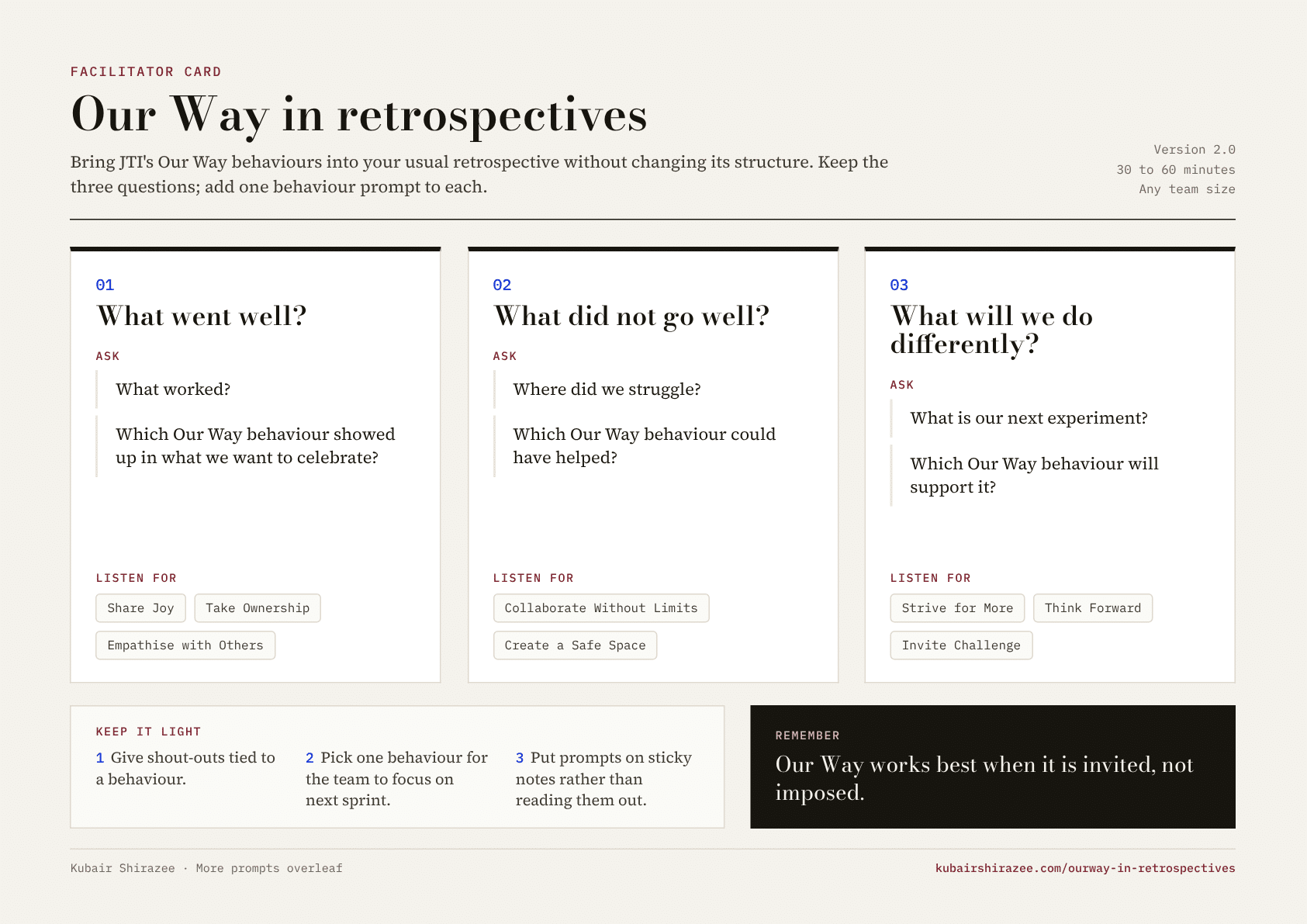
The card keeps the standard three-question retrospective and adds one Our Way prompt to each question.
What went well? Ask what worked, then whether any Our Way behaviour shone through in what the team wants to celebrate. Share Joy, Take Ownership and Empathise with Others are common ones here.
What did not go well? Ask where the team struggled, then whether a behaviour could have helped. More collaboration, or a safer space to raise a problem early, often comes up.
What will we do differently? Ask what the next experiment is, then which behaviour supports it: Strive for More, Think Forward or Invite Challenge.
Keep it light. Give shout-outs tied to a behaviour, pick one behaviour for the team to focus on next sprint, and put a few prompts on sticky notes rather than reading them out. Our Way works best when it is invited, not imposed.
Download the facilitator card (PDF, two pages)
One prompt for each behaviour
For teams that want to go further, one question per behaviour, to pick from rather than to work through:
| Behaviour | A question for the retrospective |
|---|---|
| Empathise with Others | Whose needs did we miss this sprint, inside the team or outside it? |
| Collaborate Without Limits | Where did we wait on another team, and what would it have taken to work with them directly? |
| Share Joy | What is worth celebrating that nobody has mentioned yet? |
| Take Ownership | Which decision did we wait on that we could have made ourselves? |
| Focus on Value | What did we finish that nobody will use? |
| Strive for More | What is one thing we do every sprint that could be simpler? |
| Create a Safe Space | Was there something someone held back from saying? |
| Invite Challenge | Whose feedback did we ask for, and whose did we not? |
| Challenge for Better | Which assumption should we have questioned sooner? |
| Focus on Consumers | When did the consumer last come up in our conversations? |
| Think Forward | What do we see coming that we are not ready for? |
| Make Responsible Choices | Did we take a shortcut that someone else will pay for later? |
Using the card with your own values
Swap the Our Way behaviours for your organisation’s own. Keep the three questions, keep it to one prompt per question, and resist turning the retrospective into a values audit. The point is for the team to notice, not to score itself.
How it worked in practice
Whilst I was Regional Transformation Lead for JTI MENEAT, from October 2023 to December 2025, I used this card across a number of markets in the region, with teams that were already holding retrospectives on a regular rhythm and were ready to look at how they worked together, as well as what they delivered. I facilitated the first sessions myself, and after a couple handed them over to JTI’s internal transformation enablers and agile ambassadors, who ran them with their own teams and taught others to do the same. What changed, in my view, was the language: teams described their work in their own words, tied to how they were shaping their behaviours through Our Way. Which behaviours came up varied from team to team and market to market, but Collaborate Without Limits and Invite Challenge appeared in most. Across the programme, JTI MENEAT’s own 2025 survey recorded 82% cross-functional collaboration, against an industry benchmark of 59% (Digital.ai, 17th State of Agile Report, 2023). I think the collaboration behaviours, Collaborate Without Limits, Share Joy and Empathise with Others, played a part in that, though the survey did not measure the card on its own.
Agreeing values is the easy part. The harder part is seeing them in the decisions people make on an ordinary Tuesday. If that is the gap in your organisation, the hire page shows the work behind this card, and the workshops page covers running sessions like this with your own teams.
Related tools
For a refresher on the format itself, see facilitating timeboxed retrospectives. The topic triage matrix helps a team decide where a topic belongs in terms of action, ownership and priority. For a lighter reflection format, try Lean Coffee.
Our Way in retrospectives: common questions
What are the Our Way behaviours?
JTI’s twelve behaviours, grouped under four pillars: Start with us, Make it count, Welcome challenge, and Shape tomorrow today.
Do I need to change my retrospective format?
No. The card adds one prompt to each of the three standard questions.
Can I use the card with other company values?
Yes. Replace the Our Way behaviours with your own and keep the same three questions.
How long does an Our Way retrospective take?
30 to 60 minutes, the same as a usual retrospective.



Last reviewed: November 2026.