Lean Coffee: how to run one, step by step
You have sat in that meeting. Twenty minutes in, you are wondering why you are there, what you are getting from it and what anyone is getting from you. You are in good company: in Atlassian’s 2024 survey of 5,000 knowledge workers, people rated their meetings ineffective 72% of the time, and 54% said they often left without knowing the next steps or who owned them.
Open Space has a rule for this, the law of two feet: if you are neither learning nor contributing, walk away. It is a good rule, and at work it is rarely an option, because the chances are you were invited precisely because you have something to add and something to gain. So the better question is how to run the meeting so that you can.
Lean Coffee is one answer. It is a structured meeting with no agenda set in advance: the people in the room propose the topics, vote on which matter most and then discuss them one at a time against a timer. Jim Benson and Jeremy Lightsmith started it in a Seattle coffee shop in 2009, and it has since travelled well beyond software teams. This guide covers the five steps, the timings I use and what to do when a session drifts.
I have used Lean Coffee with every client I have worked with since around 2013, and the example I lean on in this guide is the Agronomy team at JTI in Malawi, who reset their weekly team meeting with it in 2025.
At a glance
| Board | Four columns: To Do, Doing, Done and Actions |
| Doing limit | One topic at a time |
| Pitch | 30 seconds or less per topic |
| Votes | Three each, as a starting point |
| Timebox | Five minutes, then a thumb vote for two more |
| Group size | 5 to 10 works best; 12 in the Malawi example below |
| Session length | 45 to 60 minutes, weekly, in the Malawi example |
| Kit | Sticky notes, markers, a timer, and a wall or a Miro board |
When to use it, and when not to
Lean Coffee earns its place when a group has plenty to talk about and no agreed order to talk about it in, which is why it suits communities of practice, team catch-ups and retrospectives. It is a poor fit when a single decision needs papers read and numbers checked beforehand, because the format rewards whatever the room cares about on the day.
Lean Coffee in practice: the Malawi Agronomy team
Between June and October 2025 the Agronomy team at JTI in Malawi piloted a reset of its weekly team meeting, built on Lean Coffee and aimed at moving the hour from long talks to clear outcomes.
At the end of October I ran a short pulse survey with the 12 people who take part in that meeting every week, from Associates through to Area, Technical and Business Managers, and left out skip-level leaders because they do not sit in it. The team rated meeting effectiveness at 3.92 out of 5, participant engagement at 4.00, priority clarity at 3.67 and decision clarity at 3.58, and reported saving about 53 minutes per person per week.
These are the team’s own ratings from one survey of 12 people in October 2025, so they describe how the people in the meeting experienced the change and should be read as that. When asked what was working, the answers were short: “time saving”, “prioritisation of tasks” and “time and focus-oriented discussion targeting unresolved issues”.
The same survey showed where the format alone was not enough. Priorities were clearer than decisions, which meant the team agreed on what mattered sooner than it agreed on who would do what by when, and the front-line Associates rated the meeting lower than the managers and specialists did. Both findings shaped the fixes further down this page.
A second example: a leadership team’s cadence
In February 2024 the leadership team of JTI’s Middle East and Global Shisha cluster met twice every four weeks for 150 minutes at a time, working through a structured agenda that took them hours to reach the end of. We replaced that with a Lean Coffee format and shorter, more frequent meetings, so that the team’s own votes decided what was discussed first. The cadence we designed came to three and a half hours every four weeks against the five they had been spending, which gave the team back an hour and a half.
The people in that room were the general manager and the ex-com, eight people in all, so an hour and a half given back every four weeks comes to twelve executive hours a timebox and, over the thirteen timeboxes in a year, around 156. I can’t publish what an hour of a general manager’s or a director’s time costs, but you know what it costs in your own organisation, so do the sum for your leadership team.
How to run a Lean Coffee in five steps
1. Set up the board
Draw four columns on a wall or a Miro board and label them To Do, Doing, Done and Actions. Put out sticky notes and markers, and have a timer that everyone can see. The Doing column holds one topic at a time, and that limit is what keeps the conversation from splitting into three.
2. Generate topics
Everyone writes the topics they want to discuss, one per sticky note, and then introduces each in 30 seconds or less so that the room knows what it is voting on. Similar notes can be grouped at this point, with the agreement of the people who wrote them.
3. Vote to set the order
Give each person the same number of votes, three is a good starting point, and let them place dots on the topics they most want to hear discussed. The topics with the most votes go to the top of To Do, and the order of the session is now set by the room and not by whoever called the meeting.
4. Discuss against the timer
Move the top topic into Doing and start a five-minute timer. When it rings, ask for thumbs: up to carry on, down to move on. If the room wants to continue, give the topic two more minutes and use them to reach an action, then move the note to Done and pull the next one.
5. Close with actions
Keep the last few minutes to read back the Actions column, with a name against each one, and photograph the board so that the record does not depend on anyone’s memory. This step is optional in the textbook version; I would not skip it.
Running it remotely
The format works on a shared board as well as it does on a wall, provided everyone can see the timer and move their own notes. Michael de la Maza’s Miro Lean Coffee template gives you a board ready-made.
Using it for a retrospective
Lean Coffee is a format and a retrospective is a purpose, so the two combine easily: ask the team what they want to talk about from the last timebox, and let the votes decide where the time goes. The Actions column matters more here than anywhere, because a retrospective that produces no change is a conversation the team will stop turning up for. My guide to facilitating retrospectives covers the other formats.
What goes wrong, and what I do about it
These four come from the Malawi Agronomy team, where the survey named the frictions and the team tried a small fix for each.
- The timebox creeps and old topics come back. Keep the timer where everyone can see it, and take 15 seconds at the end to tally what slipped.
- Done fills up and Actions stays empty. Before a note leaves Doing, stamp it with a Decision, the person Accountable and a Date. The team called this the D.A.D. close, and one person reads the owners and dates back before the meeting ends.
- Topics crowd the board that have little to do with the work. Tie every topic to the team’s top three priorities, which in Malawi were crop priorities, and park the rest. The Topic Triage Matrix helps you decide where a parked topic belongs.
- The people closest to the work get the least from the meeting. Send a short recap within ten minutes of the close, on WhatsApp in Malawi’s case, with the owner and due date against each action.
If you want to know whether it is working, four measures are enough: actions closed within seven days, decision latency (the days from a decision to its first step), topics that reappear two weeks running, and how far the meeting runs over its planned length.
Questions people ask about Lean Coffee
Why is it called Lean Coffee?
It began in Seattle in 2009 as a way for people to discuss Lean techniques in knowledge work without setting up a formal organisation, and they met in a coffee shop.
How long does a Lean Coffee take?
At these timings each topic takes five to seven minutes, so the length depends on how many topics you want to reach. The Malawi Agronomy team ran theirs weekly in 45 to 60 minutes.
How many people can take part in a Lean Coffee?
It works best with 5 to 10 participants; however, the Malawi Agronomy team’s experiment showed it works just as well with 12 people.
Do you need a facilitator for Lean Coffee?
Someone has to keep the timer and move the notes, though that person can change from one session to the next.
Is Lean Coffee the same as a retrospective?
No. A retrospective looks back at a period of work in order to improve the next one, and Lean Coffee is one of several formats you can run it in.
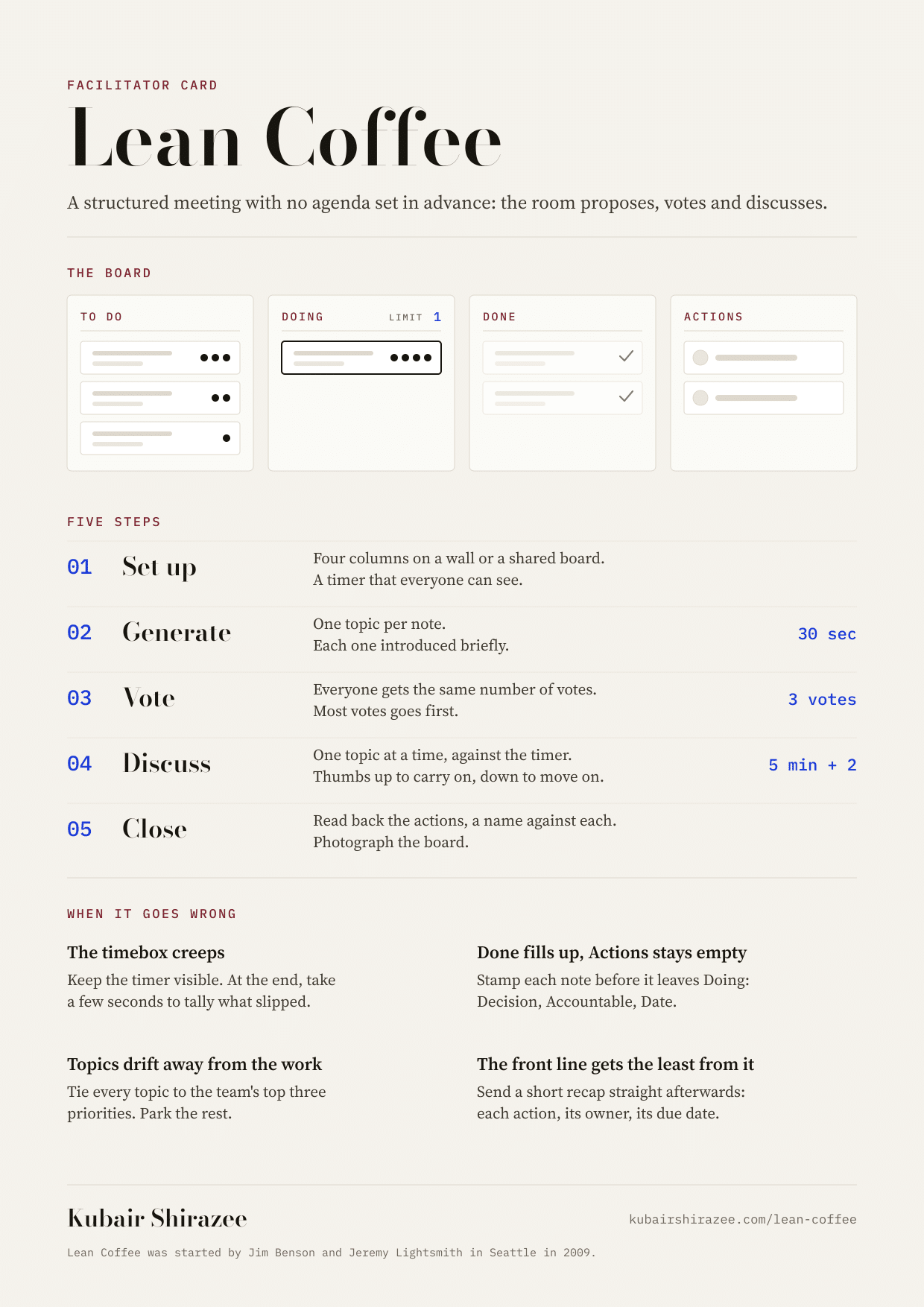
Take the one-page card
So the next time you are invited to a meeting with a long agenda and no clear way through it, or you are the one who has to call it, take the card with you. The five steps, the board and the timings fit on one printable page, so you can pin it next to the board and run the first round before anyone has had time to wonder why they are there. Download the Lean Coffee facilitator card (PDF).
When the same topics keep coming back
When the same topics return to the board session after session and nothing changes, a better meeting format will not fix it, because the decisions behind those topics are stuck somewhere else. That is the work I do with leadership teams and delivery teams in my workshops.