The wall where the hidden rules live
What happens when you give a room three minutes of silent writing and a set of category headings.
Every organisation has two sets of rules for prioritisation. The official rules live in planning documents, governance frameworks, and strategy decks. The real rules live in the habits, workarounds, and unspoken agreements that determine what actually gets done.
The official rules say: strategic alignment drives prioritisation. The real rules say: whoever escalates loudest gets served first. The official rules say: new work enters through a planning cycle. The real rules say: new work enters whenever a senior stakeholder sends a message. The official rules say: teams have capacity limits. The real rules say: say yes now, figure it out later.
Your team knows the real rules. They follow them every day. But the real rules are invisible, because nobody has ever written them down. They operate as shared knowledge that has never been shared out loud.
The Conflict Wall makes them visible.
Three minutes of silence
The exercise is structurally simple. Seven headings go up on a shared wall: Urgency Override, Capacity Blindness, Unclear Ownership, Hidden Veto, Cross-Functional Dependency, Upstream Demand, and a final heading marked Most Urgent. Each heading carries a short definition so the room knows what belongs where.
Participants get a stack of cards and one instruction: think of a real example where prioritisation broke down, failed, or was overridden. Write it on the card using a specific structure (what happened, who was affected, what the impact was). Place it under the heading that fits.
The room goes silent.
Three minutes later, cards start appearing on the wall. Then more. Then a cluster forms under one heading. Then another. Within ten minutes, the wall has fifteen to twenty cards and the room can see, for the first time, where the friction actually lives.
What the wall reveals
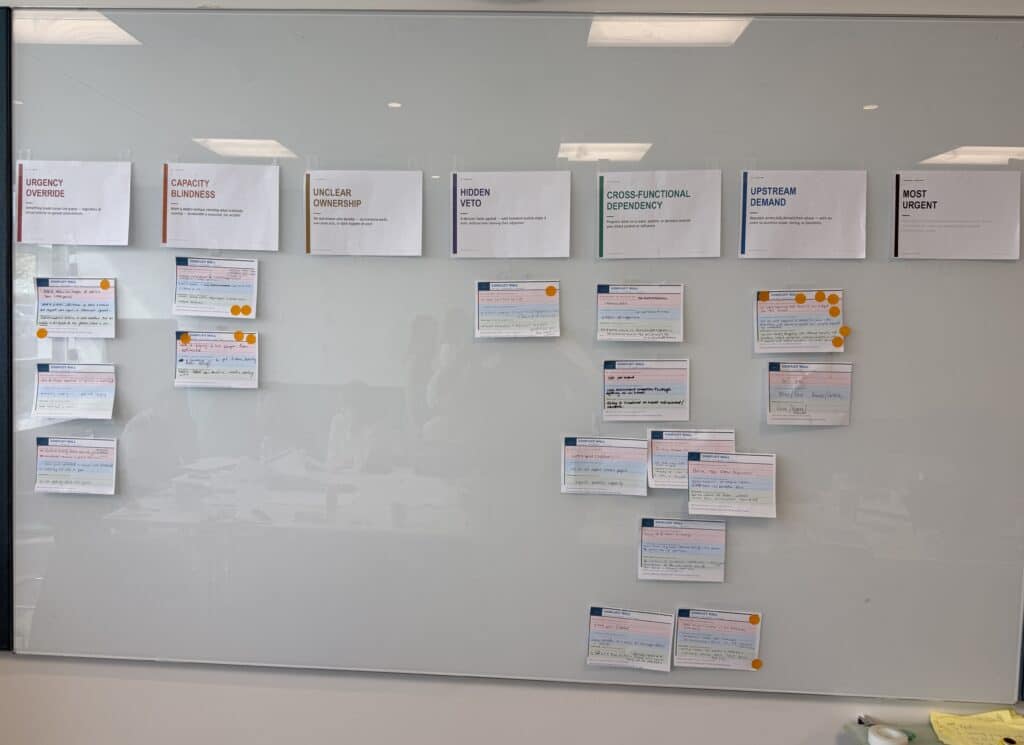
The patterns are consistent. Across the sessions in this engagement,
and in similar work elsewhere, three things show up every time.
The dominant pattern is structural, not behavioural. The heaviest cluster of cards typically appears under Cross-Functional Dependency. Not “someone made a bad decision” but “the handoff between our team and theirs broke down” or “we depend on an input we don’t control and it arrived late.” The second heaviest cluster is usually Urgency Override or Hidden Veto. What this means is that the room’s prioritisation problems are overwhelmingly system-design failures: handoff gaps, unclear interfaces, external dependencies arriving without warning. They are not failures of individual discipline or courage.
This matters because the usual response to prioritisation breakdown is to fix the people: train them, coach them, hold them accountable. The wall tells a different story. The people are navigating a system that makes weak prioritisation likely. Fix the system and the people’s behaviour changes.
Rework is hiding inside multiple categories. Cards that describe the same initiative appearing twice, or a decision being revisited after it was supposedly agreed, or work being redone because the brief changed mid-delivery, show up under several different headings. They might land under Urgency Override (the brief changed because someone senior intervened), Unclear Ownership (nobody knew who had authority to change the brief), or Cross-Functional Dependency (the rework was triggered by a late input from another team). The rework is the same. The heading is different. That means the wall is surfacing a single systemic issue that has multiple symptoms.
The bottleneck has a shape, not a name. In this engagement, a recurring pattern emerged across multiple cards: work stalling at a single coordination point where one role was expected to review, approve, and sequence across multiple workstreams simultaneously. The cards didn’t name an individual as the problem. They described a structural bottleneck where too many decisions funnelled through too few people. That distinction is important. A wall that produces “this person is the problem” creates blame. A wall that produces “this coordination point is overloaded” creates a design conversation.
The dot vote and the MOST URGENT card

Once the cards are on the wall, each participant gets a small number of dots and votes for the card that describes the sharpest systemic block they experience. Not the most annoying. Not the most recent. The one that, if resolved, would unlock the most.
The votes cluster. They always cluster. And the clustering is the point, because it turns twenty individual frustrations into one shared priority. The card with the most dots gets moved to the final heading on the wall: Most Urgent. The instruction on that heading reads: “This is the pattern the room has named as the sharpest systemic block today.”
Named. By the room. Not diagnosed by a consultant. Not escalated by a leader. Identified, voted on, and placed by the people who live with the consequences.
That card becomes the first thing discussed in the follow-up coaching cadence. It becomes the test case for whether the new prioritisation criteria actually work. It becomes the reference point when someone asks “but has anything actually changed?” weeks later.
Why this is scaffolding
The Conflict Wall is not a venting exercise. It is a piece of scaffolding that does three specific things.
It gives the room a language for system problems. Before the wall, the room had complaints. After the wall, the room has categories. “We’re too busy” becomes “we have a cross-functional dependency problem.” “Things keep changing” becomes “we have an urgency override pattern.” Categories are actionable in a way that complaints are not, because categories point to specific structural fixes.
It separates the system from the people. The headings are deliberately framed as system conditions, not personal failings. “Urgency Override” is something that happens to the team’s priorities, not something someone did wrong. That framing makes it safe to write honestly, which makes the wall accurate, which makes the diagnosis useful.
It creates a shared, physical record that outlasts the conversation. The wall stays up. The cards stay visible. When the room reconvenes for a follow-up check-in and someone says “this happened again,” they can point to the card that described it three weeks earlier. The wall becomes a baseline, not just a moment.
What to do if your team’s real rules are invisible
You don’t need a facilitator to build a Conflict Wall. You need a wall, seven headings, a stack of cards, and three minutes of silence.
Print the headings. Define them clearly enough that anyone in the room knows which one fits their example. Give the room cards with a simple structure: what happened, who was affected, what the impact was. Set a timer. Let people write in silence. Let the cards go up.
Then look at where they cluster.
The cluster is the diagnosis. Not where individuals failed, but where the system makes weak prioritisation likely. That is where the fix lives. And the room just told you where it is.
This is the third in a series on the structures underneath good prioritisation. Previously: Prioritisation is a scaffolding problem and What your team knows about prioritisation (but has never seen together). Next: the criterion you’re already using, and why it’s urgency.