Agile meeting agenda template: five invites that say why we are meeting
Open your calendar and find your team’s next sprint review. If the invite is a title, a time and a video link, then the people you have invited do not know why they are coming, what they should bring or what they ought to leave with, and the opening minutes of the meeting will go on telling them.
I started writing my invites as charters to fix exactly that. This agile meeting agenda template is the result: five calendar invites, one for each session in a team’s cadence, and each one says in a few lines what the session is for, what to come prepared with and what you leave with. Copy the text into the body of your recurring invite, change what does not fit your team, and let the invite do the briefing before anybody joins the call.
These invites are what is left after years of experimenting, getting it wrong, learning and trying again, with teams in technology, pharmaceuticals, life sciences, FMCG and telecoms, with NGOs, and on the street with Peace Through Prosperity, my social innovation lab, where the teams are hired from the communities they serve. The Peace Through Prosperity teams used the plain-language ancestors of these invites and helped refine the version you see here, and they are the reason it reads the way it does, because most of the people in the room are entrepreneurs of circumstances who have never heard of software development, let alone Scrum. If an invite makes sense to a team working out of a neighbourhood in Karachi, Sanaa or Cairo, where nobody is going to look up what a sprint is, then it will make sense to your stakeholders in head office too, and so every line here has had to earn its place with people who had no reason to be patient with jargon.
In brief. Kubair Shirazee’s agile meeting agenda template is a set of five calendar invites, written as short charters, for timebox (sprint) planning, the alignment meeting (daily scrum), refinement, the review and the retrospective. Each gives the purpose of the session, what to bring, what you leave with, who takes part and a suggested length. They have been tested with corporate teams and with community teams on the street, which is why they use plain terms. It is free to copy from this page or to download as a Word document.
Download the invites as a Word document, or open them as a PDF.
How to use the invites
Each section below has the same four parts: the suggested length and frequency, who takes part, the text to paste into the invite, and a line or two on how we behave in the room. The timings are suggestions, and the team should decide how often it needs to meet. This is a template, so inspect and adapt.
A word on the words. I say timebox where Scrum says sprint, and alignment where Scrum says daily scrum. That habit comes from the street: many of the people who receive these invites have never read the Scrum Guide and should not have to in order to turn up prepared. Every heading gives the plain name first and Scrum’s name after it, so you can use whichever your team already knows.
Four of the five sessions are events in the Scrum Guide. Refinement is the fifth here: the Guide treats it as an ongoing activity, and I give it an invite of its own because a team that leaves it to chance ends up doing it in planning.
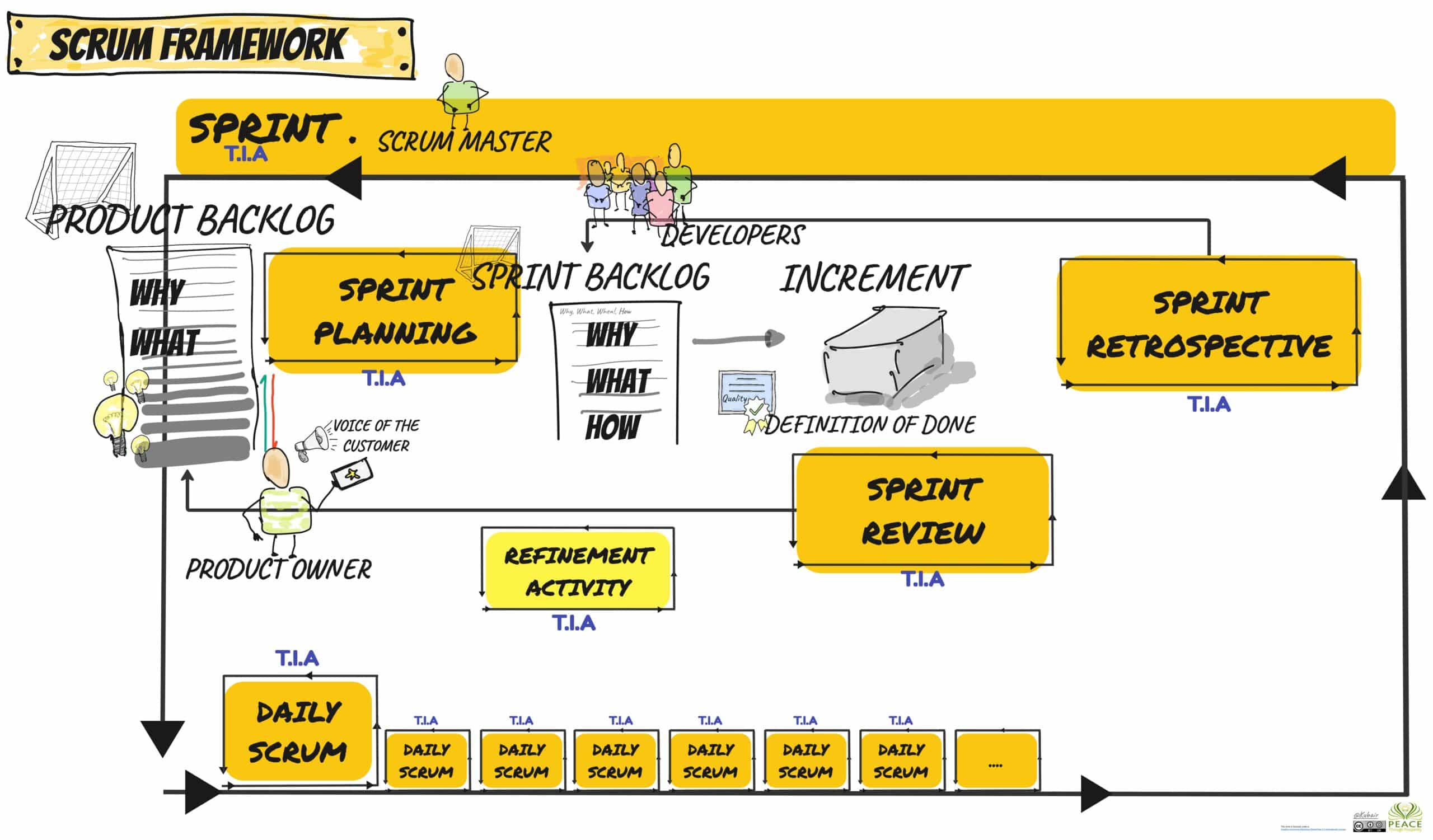
Planning: agreeing what we will work on next (Scrum: sprint planning)
Planning is where the team agrees a goal for the coming timebox and the list of work that gets it there. Scrum calls it sprint planning, and this is the agenda and invite for it.
Suggested length: 45 to 60 minutes
How often: once per timebox
Who takes part: the whole core team
Invite title: Planning
Purpose: discuss, collaborate and plan the work for the coming timebox (the fixed stretch of time we plan and work in; Scrum calls it a sprint).
Come prepared with: the items to be worked on, and your availability for the timebox, marked in the team calendar so that everybody can see it. Bring courage, transparency and your authentic self!
Leave with: a goal for the timebox, and our list of things to do (the backlog) that lets us work towards it.
In the room: know what you are currently working on before you arrive. If you are raising new work, be ready to explain why it matters. Observers are welcome by invitation, and they listen until the end.
If planning is where your team struggles, the sprint planning guide has a facilitator script, and Working in Time Boxes explains how to size the timebox in the first place.
Alignment: checking we are still on course (Scrum: daily scrum or stand-up)
The alignment meeting is a short, regular check between the people doing the work on whether they are still on course for the timebox goal. Scrum calls it the daily scrum, many teams call it the daily stand-up, and this is the agenda and invite for it.
Suggested length: 15 minutes
How often: daily, or Tuesday and Thursday. The team decides how often it needs to align
Who takes part: the developers, meaning the people doing the work. A delivery manager is optional and can observe
Invite title: Alignment
Purpose: regular alignment, to optimise collaboration and performance.
Come prepared with: the goal for the timebox (the fixed stretch of time we plan and work in; Scrum calls it a sprint), our list of things to do (the backlog), an up-to-date board showing who is doing what, and a focused conversation.
Leave with: an updated plan for reaching our timebox goal.
In the room: talk to your teammates; these are peer conversations, not status updates. If you are stuck, say so, because that is the whole point of meeting. Anything that needs longer than a minute or two is picked up afterwards by the people it concerns.
Refinement: getting upcoming work ready to start (Scrum: backlog refinement)
Refinement is where the team breaks upcoming work down until the items at the top of its list of things to do are clear enough to start. Scrum calls it backlog refinement, and this is the agenda and invite for it.
Suggested length: 30 to 45 minutes
How often: twice a week, ideally Tuesday and Thursday. The team decides how often it needs to meet
Who takes part: the product manager or product owner and the developers. A delivery manager is optional. Let the team self-manage
Invite title: Refinement
Purpose: break down and prioritise the items in our list of things to do (the backlog), and work out the “how” for the “whats” that deliver value.
Come prepared with: prioritised items from that list. Bring an empirical mindset, heuristic neurons and your slicing knives!
Leave with: the items at the top of the list closer to “ready enough for action” in the coming timebox (the fixed stretch of time we plan and work in; Scrum calls it a sprint).
In the room: if you have been invited, your knowledge is needed, so contribute. Challenge assumptions now, while it is still cheap to change course. Leave with a shared understanding of the work as well as a list of tasks.
Review: showing what we finished and asking for feedback (Scrum: sprint review)
The review is where the team shows what it finished in the timebox and asks the people it was built for what they make of it. Scrum calls it the sprint review, and this is the agenda template and invite for it.
Suggested length: 45 to 60 minutes
How often: once per timebox
Who takes part: the whole team and a wide range of the people the work is for (stakeholders)
Invite title: Review
Purpose: collaborate on what was done, ask for feedback and foster collaboration.
Come prepared with: the goal for the timebox (the fixed stretch of time we plan and work in; Scrum calls it a sprint), our list of things to do (the backlog) and the work we finished (the “done” items). We show what we made where we can, and then we ask the people we are doing this work for (our stakeholders) for feedback. Bring curiosity, inspiration and jazz!
Leave with: feedback from our stakeholders, and new ideas to go into the backlog.
In the room: we only show completed work. Feedback and questions are expected, and if something we show affects your area, say so there and then.
A version for your guests
The people you are doing the work for, your stakeholders, are the ones most likely to arrive unsure of what is expected of them, so I add a few lines to the invite they receive:
Thank you for joining us. You do not need to read anything beforehand or bring anything with you. We show real work, not polished presentations, and your questions are the test the work needs. What you say here shapes what we do next.
If you want to send more than a few lines, there is a one-page guide for guests to go with the invite.
One sentence that keeps a review from becoming a status report
Before the session, each person presenting writes their update in this frame:
For [who this is for], [what we learned]. This timebox we [what we changed]. Next, [the one thing that happens next]. This matters because [the goal, with a number if we have one].
There is more on telling the story of your work in the storytelling guide.
Retrospective: improving how we work together (Scrum: sprint retrospective)
The retrospective is where the team looks at how it worked, as distinct from what it delivered, and agrees one thing to improve. Scrum calls it the sprint retrospective, and this is the agenda and invite for it.
Suggested length: 30 to 60 minutes, depending on the number of people in the team, the context and nature of their work, and their maturity. If in doubt, book the hour and finish early
How often: once per timebox
Who takes part: the whole core team, and nobody else
Invite title: Retrospective
Purpose: look at our performance, relationships, processes and tools, and find what to improve.
Come prepared with: our list of things to do (the backlog), and metrics where we have them. Bring courage and transparency, and call it as you see it!
Leave with: a review of the improvements we agreed last time, and a plan for one improvement action in the coming timebox (the fixed stretch of time we plan and work in; Scrum calls it a sprint).
In the room: this is a closed session. What is said here is for the team’s own learning, and it is not reported upward or shared outside the room.
This invite keeps to one format on purpose. For how to run the session itself, including a facilitator script with prompts and timings, see Facilitating Retrospectives.
Agile meeting invites: common questions
What should a sprint review invite say?
A sprint review invite should say what the session is for, what to bring and what people leave with. In this template the review’s purpose is to collaborate on what was done and ask for feedback, the input is the goal, the list of things to do (the backlog) and the finished work, and the outcome is feedback from the people the work is for, and new ideas for the list.
How long should each agile meeting be?
The suggested lengths in this template are 45 to 60 minutes for planning, 15 minutes for the alignment meeting, 30 to 45 minutes for refinement, 45 to 60 minutes for the review and 30 to 60 minutes for the retrospective, depending on the size of the team, its work and its maturity. If in doubt, book the hour and finish early.
Do I need to know Scrum to use these invites?
No. The invites use plain terms such as timebox and alignment, and each heading on this page gives the Scrum name alongside, so a team new to agile and a team that already runs sprints can both use them.
Is refinement one of the Scrum events?
The Scrum Guide describes refinement as an ongoing activity, not as one of its events. It has its own invite here because most teams find it easier to protect the time than to fit refinement in around everything else.
Is the template free?
Yes. You can copy the invite text from this page or download it as an editable Word document, and adapt either to your team. No credit is needed when you use it in your own calendar. If you republish the template or share an adapted version, it is licensed CC BY-SA 4.0: credit Kubair Shirazee and share your version on the same terms.
The problem underneath the problem
If your events run to time but the same problems come back every sprint, the agenda is not where the gap is. The bootcamp works on what happens inside each event, so the conversations lead to decisions: see the workshops.
Download the invites as a Word document, or open them as a PDF.
Last reviewed: November 2026.