Decision latency
Nobody is slow on purpose. They’re slow because nobody is sure it’s their call.
Decision latency is the time between a decision becoming necessary and someone with the authority to make it actually making it and acting on it. It is the gap where work waits, and most organisations never see it: they see a project that “slipped”, a team that “lacks urgency”, a steering group that “needs more information”, when the cause usually has a different name.
What is decision latency?
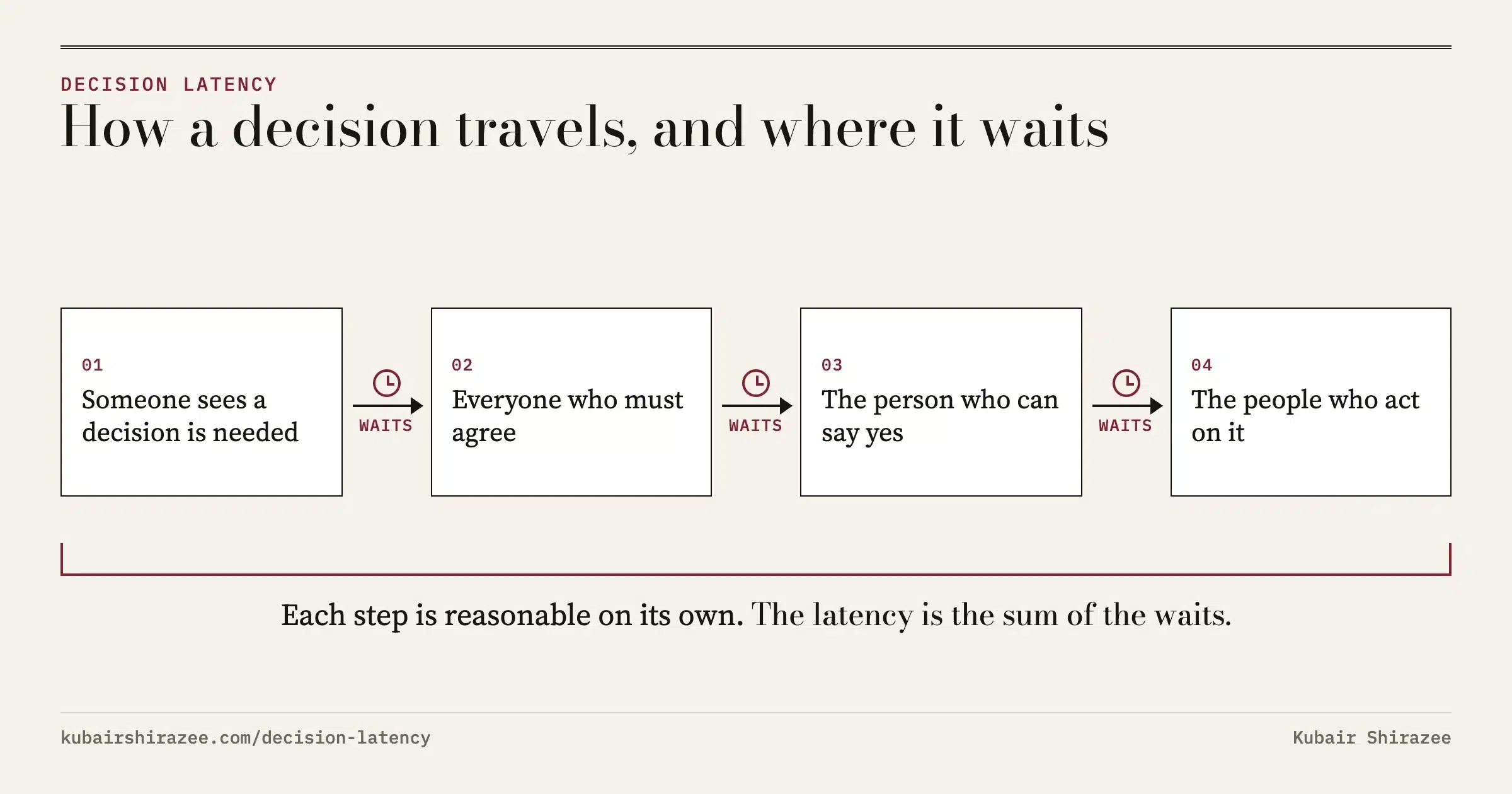
Decision latency is the delay built into how a decision travels: from the person who sees it is needed, through everyone who must agree, to the person who can say yes, and back to the people who act. Each step is reasonable on its own, and the latency is the sum.
It shows up as a familiar sentence: “We’re waiting on a decision.” Ask whose decision, and the room often goes quiet.
Is decision latency a speed problem?
No. Telling people to move faster assumes they are choosing to be slow, and in most of the organisations I have worked with they aren’t: they are responding sensibly to a system that makes waiting the safest option, because decisions are designed to travel too far, too carefully and too late. That makes decision latency a design problem, with speed as the symptom.
What causes decision latency?
Three conditions produce most of it:
- Authority sits far from the work. The person closest to the problem isn’t the person allowed to decide, so hesitation becomes rational.
- Consequences are asymmetric. A wrong decision is punished; a late one rarely is. Escalation feels safer than ownership.
- Certainty is rewarded over learning. If every decision has to be right first time, delay becomes protection.
Under pressure, the system teaches four lessons: don’t decide too early, don’t decide alone, don’t decide without cover, don’t decide unless you’re sure. Each one is sensible. Together they add days or weeks to every choice that matters.
That is why decision latency is better read as a signal than as a performance issue. It tells you that somewhere in the system, authority and risk are misaligned, and safety is being bought with time.
How do you measure decision latency?
You measure decision latency by tracing real decisions, not by surveying opinions about speed. A simple version takes an afternoon:
- Pick ten recent decisions that mattered to delivery: a priority call, a budget release, a go or no-go.
- Record three dates for each: when the decision first became necessary, when it was made, and when anyone acted on it.
- Count the hand-offs: how many people or forums each decision passed through.
- Note where it waited longest, and who it was waiting for.
The pattern matters more than the average: if most of the waiting happens at the same forum, the same level or the same missing owner, you have found the design problem, and the cluster is the diagnosis.
How do you reduce decision latency?
You reduce it by redesigning the conditions rather than by demanding pace. The most reliable lever I have seen is operating cadence: a fixed rhythm where decisions have a place to land.
I saw this clearly in a field-facing agronomy team in Africa, working close to farmers, seasonal deadlines and real consequences. Priorities were clear but decision ownership was not, so people agreed on what mattered and then stalled on who decides next, and by when.
What changed was the rhythm rather than the pressure or the motivation: each week, each person named one decision they owned, one blocker they needed removed and one commitment they were making before the next session. Decisions became visible, expected and revisitable. Follow-through improved, and nearly an hour per person per week was reclaimed.
Mohammad Jaber, Country Manager, Lebanon, described the same shift after a crisis: “What impressed me wasn’t the speed — it was the discipline. Fifteen minutes every morning, a truthful weekly review, and managers removing one blocker a day.”
Cadence works because it changes what is safe. When a decision will be looked at again next week, making it now stops feeling like a gamble.
Why AI makes decision latency visible
AI doesn’t create decision latency. It timestamps it.
When an agent logs a recommendation at 9am and the action happens the following Thursday, the gap was always there. Now it is on the record. That is why so much AI work turns into decision design work: decision rights, ownership at the point of decision, and the hand-offs nobody designed.
Further reading
- Decision latency is rarely about speed: the essay this page grew from.
- AI won’t fix your organisation. It will show you what’s broken.
- The decision system your AI strategy is about to expose
- The pilot worked. Nothing changed.
- Prioritisation is a scaffolding problem
- Scaffolding is not an event
- Eisenhower Matrix vs Topic Triage Matrix: two ways to sort a crowded list.
So here’s my question, and I’d genuinely like an answer rather than agreement: which decision in your organisation is waiting right now, and does anyone know whose it is?
If you’d like to trace it together, grab 20 minutes on my calendar or just compare notes over a virtual chai.
Last reviewed: November 2026.
