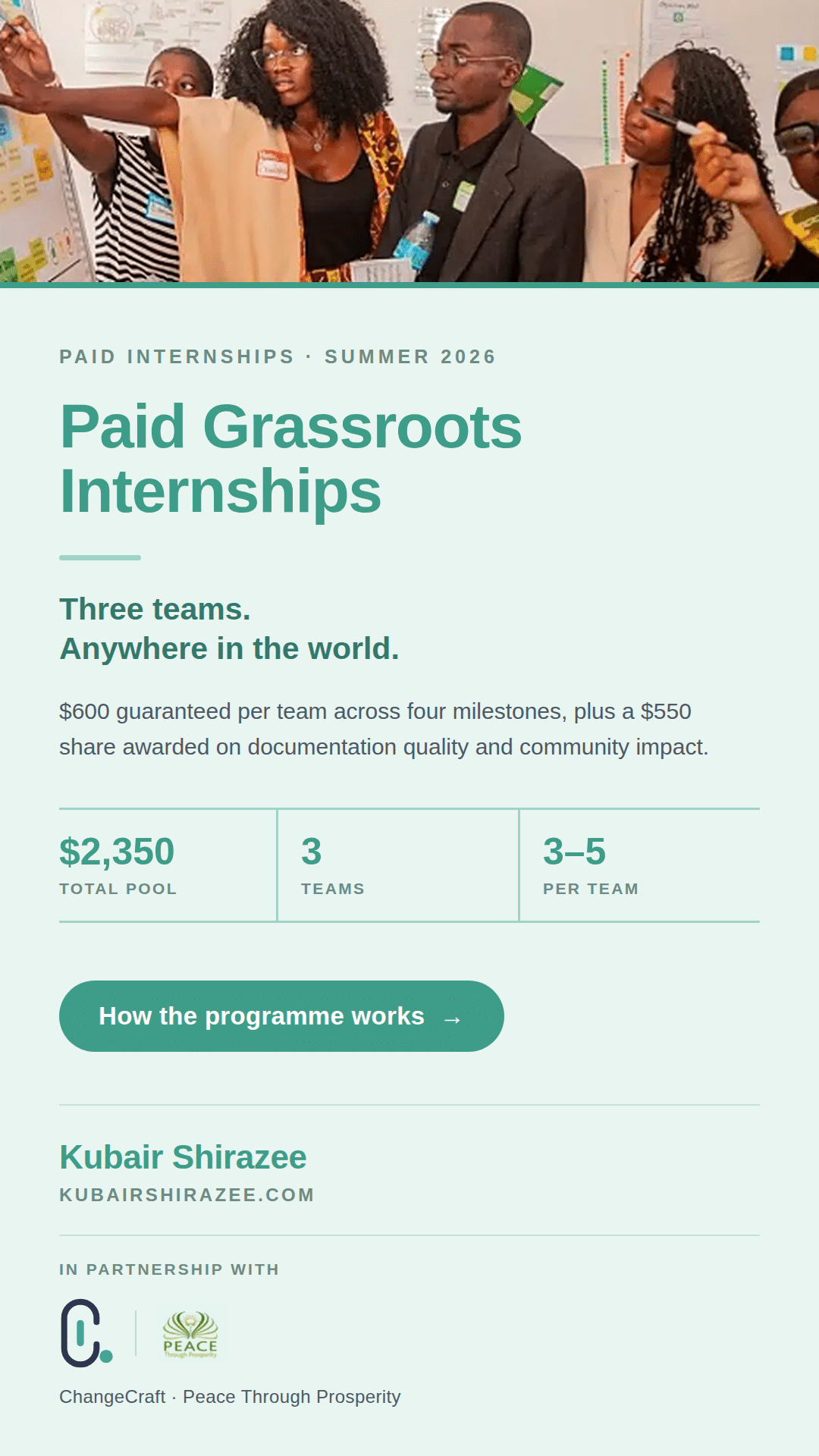
Grassroots youth programme scoring guide
Young teams run a four-week community experiment with no budget and no institutional permission, then defend what they found. What is under review is capability, not community impact, so half the marks reward behaviour rather than outcome.
Entering the Grassroots Impact Challenge instead? It scores delivery, contextual impact, data collection and storytelling: see the Grassroots Impact Challenge.
Orientation
What this guide is, and who it is for
This is the scoring guide for the Grassroots Internships: the sheet five reviewers mark each team against. Kubair Shirazee designed the programme and pays for it, and does not score it. This is the Summer 2026 edition. Each edition is dated, and the bands are revised between cohorts wherever they turn out to mislead.
The Grassroots Internships pay small teams of young people to run one experiment from the Grassroots Playbook in their own community. Four weeks, no budget, nobody’s permission. At the end each team presents what actually happened to five reviewers. Four are from outside the programme; the fifth is ChangeCraft’s engagement director, declared as such. This guide is published so that nobody has to take the result on trust afterwards.
Before you score
What reviewers are asked to do
You are here to attack the evidence, not to encourage the teams. The programme’s own claim is that these teams got better at handling evidence, so the most useful thing you can do is test whether that is true.
Where a team has overclaimed, say so on the record. Where a team has disclosed a weakness voluntarily, weight that heavily. It is the behaviour being measured.
Teams are given this guide so they know that honesty counts for more here than results do. Your job is to test whether they meant it. You hold each team’s full evidence pack before the review; score against the pack, not against the deck.
100 points
How the hundred marks are split
- Honesty of claim30
- Method improvement20
- Consent in practice20
- Transferability15
- Reach beyond people like us10
- What the team can now do5
Honesty at 30 and consent-in-practice at 20 means fifty of the hundred marks reward behaviour rather than outcome. That is the philosophy of the programme expressed as arithmetic. It is published before the review so that nobody has to take the scoring on trust afterwards, and so the awards stay defensible when the team with the weakest numbers scores well.
Six criteria
What the scoring bands mean
A band is a fixed level of performance with a fixed number of points attached, and every criterion has four of them. Award exactly one band per criterion. Award the band the evidence pack supports, not the one the presentation implies. Do not award half-marks.
Honesty of claim
30 · behaviourThe team asserts nothing beyond what its evidence carries, and names its own weaknesses before a reviewer asks.
| Band | What the evidence pack shows | Points |
|---|---|---|
| Volunteered | Every claim traces to a document in the pack. The team names its own weakest point before a reviewer reaches it: a result resting on one participant, say, or a measurement window that has closed and cannot be reopened. Null and negative results stay in the pack rather than being dropped. | 30 |
| Conceded | Every claim is supported by the pack. Weaknesses are described accurately once a reviewer raises them, but the team raised none of them first. | 21 |
| Stretched | At least one claim runs ahead of the evidence behind it. Or the presentation omits a weakness the team knew about, and that weakness surfaces only under questioning. | 12 |
| Unsupported | The team presents a figure, quotation, testimonial or outcome that its own record does not support. | 0 |
Method improvement
20 · outcomeThe method got better across the four weeks in response to what the team found, and the pack shows that improvement.
| Band | What the evidence pack shows | Points |
|---|---|---|
| Traced | The method changed across the four weeks, the team can name which finding caused which change, and the pack holds the artefact from before each change and the artefact from after it. | 20 |
| Changed | The method changed visibly. What triggered each change is asserted rather than evidenced. | 14 |
| Recorded | Learning was captured week by week and acted on in none of it. The same method ran four times. | 8 |
| Static | Nothing in the pack shows the team noticed anything. Or the method changed for the team’s own convenience, and that change is presented as learning. | 0 |
Consent in practice
20 · behaviourWhether the team published only what each participant permitted. Not whether a form was signed.
| Band | What the evidence pack shows | Points |
|---|---|---|
| Controlled | Everything published stays within what the participant permitted, everywhere in the record. Before each item left the team’s folder, a named person checked it against the permission held for it, and the team can show that check. | 20 |
| Applied | Consent was collected well and applied correctly, but from memory and goodwill. Nobody owned the check. | 14 |
| Corrected | A restriction a participant had documented was breached somewhere in the record, found by the team, and put right before the review. | 8 |
| Breached | A restriction is still breached at the moment of presenting. Or a consent is claimed that the team does not hold. | 0 |
NoteScore this criterion on the whole record, not the slides. Removing a name from the deck does not clear a breach the workbook still carries.
Transferability
15 · outcomeCould someone outside the team run this from what the team has written down?
| Band | What the evidence pack shows | Points |
|---|---|---|
| Handed over | Someone outside the team ran it from the written material, and the team then revised that material to fix whatever the handover exposed. | 15 |
| Written | The written material is complete enough that a stranger could plausibly run it. Nobody has tested that. | 11 |
| Partial | A recipe exists, mostly in the team’s heads and partly on paper. | 6 |
| Unrepeatable | Nothing usable was written down. What the team knows leaves with the team. | 0 |
Reach beyond people like us
10 · outcomeWho the work actually reached, measured rather than assumed.
| Band | What the evidence pack shows | Points |
|---|---|---|
| Measured | The team measured who it reached: distance travelled, cost to attend, or an equivalent that costs a participant something to give. Where the answer was uncomfortable, the team changed the design. | 10 |
| Corrected | The team recognised a limit in its own reach and acted on it, without measuring it. | 7 |
| Assumed | Reach is discussed and taken on faith. Headcount stands in for who. | 4 |
| Circular | The work reached the team’s own circle, and that circle is presented as reach. | 0 |
What the team can now do
5 · outcomeCapability in the team that did not exist in July, evidenced in the pack.
| Band | What the evidence pack shows | Points |
|---|---|---|
| Evidenced | A named capability, shown by something the team produced unprompted that nobody taught them to make. | 5 |
| Named | A specific capability, self-reported and plausible. | 4 |
| General | Statements about confidence and growth, without a thing the team can now do. | 2 |
| Absent | Not addressed. | 0 |
Procedure
How the panel scores
- Score alone, before you talk. Each reviewer scores all three teams independently and submits before any discussion. The final mark is the mean of the four external scores.
- Disagreement is recorded, not resolved. Where reviewers are more than one band apart on a criterion, that gap is published with the result. It is information about the guide, not a problem with the panel.
- The founder abstains. Kubair Shirazee designed and funds the programme and does not score it. He presents the cross-team synthesis and answers challenges; he does not sit on the panel.
- Score the four weeks, not the hour. Presentation quality is not a criterion. A nervous team reading from a page can score full marks.
- Expect the paradox. A team with almost no measurable results can outscore a team with strong ones. That is the guide working, not failing.
TimeEach team presents briefly and then takes questions. The exact split is published with each review; in this edition it is eight minutes and four. Reviewers hold the full evidence packs beforehand, so the presentation is for the team’s own account, not for you to learn the facts.
Explicitly excluded
What earns no marks
- Effort. Four weeks of hard work earns nothing on its own. A team that learned nothing from those weeks scores what its evidence supports, and no more.
- Production quality. Well-designed carousels, films and websites are not evidence. A team can produce three weeks of excellent promotion and nothing that measured anything.
- Scale for its own sake. Twelve people documented properly beats three thousand asserted.
- A good result. A large positive number, on its own, moves nothing on this sheet. What moves is whether you can tell how it was arrived at and what would make it smaller.
- Mentioning the programme. No team has been asked to credit the programme, its partners or its founder, and doing so earns nothing.
More on the programme: The Grassroots Playbook · Paid Grassroots Internships 2026 · Peace Through Prosperity