The Five Pressures: How Communities Are Worn Away, and the Strengths That Hold Them
Updated October 2026: nationocide.com is now Unerasable, and the five pillars are now the five pressures.
Last week, I asked what pressures communities have faced. The responses floored me -- not because they were surprising, but because they were so consistent across vastly different contexts.
Funding cuts. Planning rejections. Media vilification. Leaders targeted. Young people leaving.
Different communities. Different cities. Different countries. Same patterns.
Through Peace Through Prosperity’s work across eight countries over more than a decade, what emerged wasn’t a collection of isolated case studies. It was a framework for systematic community erasure: five pressures that wear a community away, and five strengths that hold it together.
What are the five pressures?
I’ve given them plain names, so they can be used around a kitchen table.
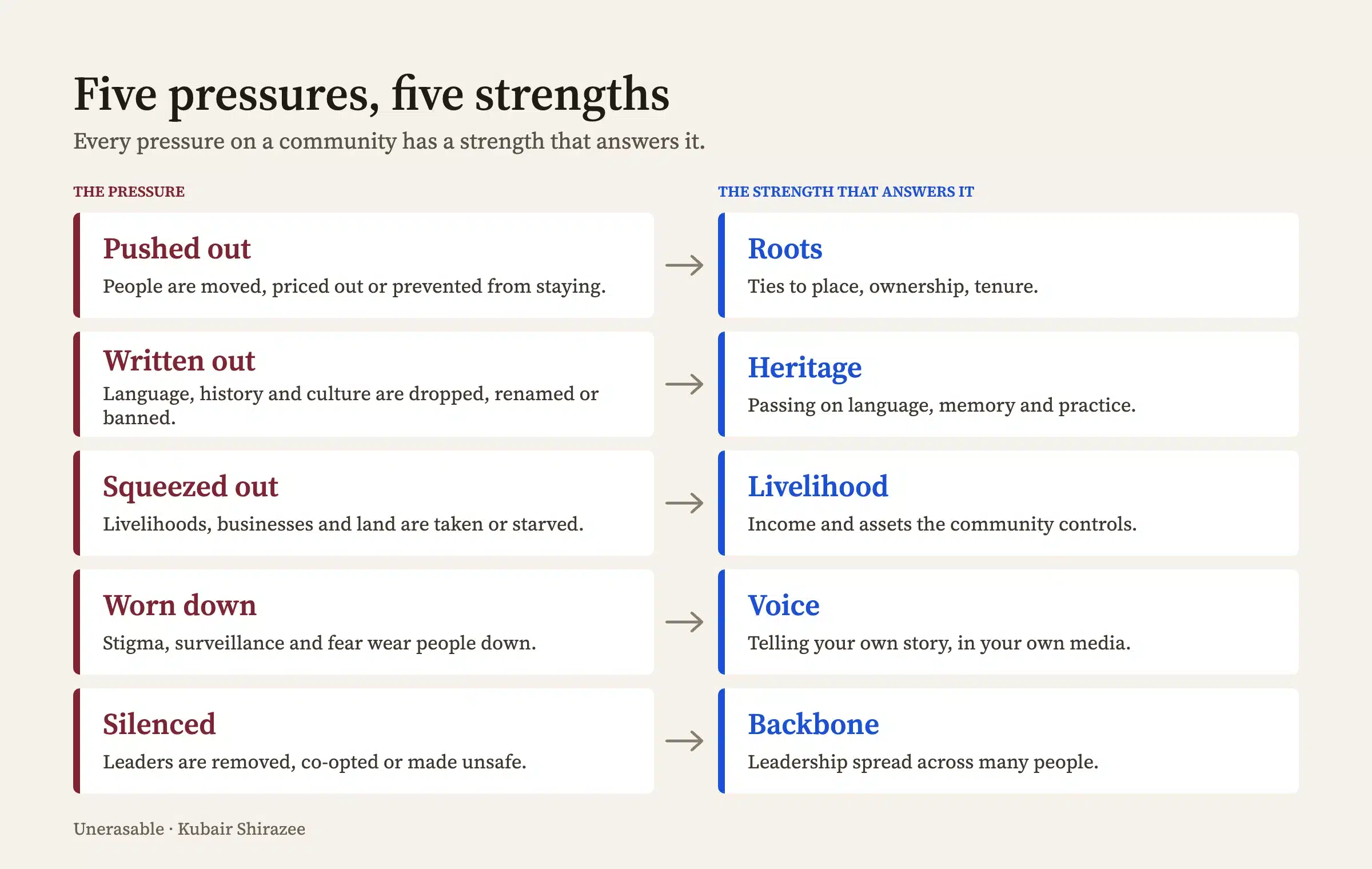
1. Pushed out
People are moved, priced out or prevented from staying. Rezoning and “regeneration” that prices communities out. Housing policy that restricts where people can live. Immigration enforcement that removes community members. Climate-forced migration.
The tools vary; the outcome is consistent: you’re no longer there.
Case in point: East London. The Runnymede Trust and CLASS report Pushed to the Margins found Tower Hamlets was the most gentrified borough in London between 2010 and 2016.
Its more revealing finding was structural. In the boroughs it tested, neighbourhoods inside the Greater London Authority’s designated Opportunity Areas were significantly more likely to gentrify, and showed higher rates of displacement.
Note what that means. If the same pattern holds in Tower Hamlets -- the report tested it in three other boroughs -- the decision shaping who would eventually leave Brick Lane was not any individual planning approval. It was a designation on a strategic map, made years before the first application landed.
Every development that followed was lawful. Each was assessed on its own merits. None was ever assessed alongside the others.
That is how this pressure works: no conspiracy required, only aligned incentives and a process that never asks the cumulative question.
The strength that answers it is Roots: ties to place, ownership and tenure. Who owns the buildings. Who holds the leases. Who knows the planning calendar before the map gets drawn.
2. Written out
Language, history and culture are dropped, renamed or banned. Curriculum changes that remove community history from education. Heritage sites neglected or demolished. Media representation that replaces a community’s understanding of itself with someone else’s.
Communities survive physical displacement if they keep their cultural coherence. This pressure goes after that coherence directly.
What holds against it is Heritage: passing on language, memory and practice. Used, taught and handed on.
3. Squeezed out
Livelihoods, businesses and land are taken or starved. Funding withdrawn from community organisations. Business licensing obstacles. Employment discrimination. Banking restrictions and financial exclusion.
Simple truth: communities can’t sustain institutions they can’t fund. This pressure makes every other pressure harder to withstand.
Its answer is Livelihood: income and assets the community controls. Most of Peace Through Prosperity’s work with micro-entrepreneurs sits here. It is slow. It is also the one we can count.
4. Worn down
Stigma, surveillance and fear wear people down. Media framing that positions communities as problems. Political scapegoating. Collective blame for individual actions. Stigma that, over time, people start to believe about themselves.
The effect is demoralisation. Communities that believe their decline is inevitable stop organising against it.
The answer is Voice: telling your own story, in your own media. Not a rebuttal campaign. A record, kept by the people it belongs to.
5. Silenced
Leaders are removed, co-opted or made unsafe. Prosecution of community leaders. Professional sanctions. Reputational attacks. Forced relocation.
Remove the people capable of coordinating a response, and the community struggles to answer the other four pressures.
And the answer to silencing is Backbone: leadership spread across many people. If one person holds the keys to the hall, the hall closes when they leave.
How do the pressures compound?
They don’t operate in isolation. They compound.
Pushing people out concentrates those who remain, which makes the squeeze on livelihoods more effective. Wearing people down makes the loss of heritage feel inevitable. Silencing the people who could organise prevents a coordinated response to all of it.
If you’re a gamer, think of it as debuff stacking: each negative status effect makes the others worse. The system reinforces itself.
The strengths can compound the same way. A community with strong roots can keep its voice more easily. A community with backbone can keep its livelihoods going when one leader is lost.
The cluster is the diagnosis. The strengths are the treatment.
Who’s responsible?
A question I get constantly: who exactly is doing this?
Honestly? Rarely a single actor with a master plan. More often, it’s state policy, corporate interest and majoritarian movements producing the same outcome through aligned incentives rather than explicit coordination.
Systematic community erasure doesn’t require conspiracy. It requires pattern recognition.
A critical distinction
These pressures describe potential mechanisms, not inevitable ones. A community facing funding cuts isn’t automatically experiencing systematic erasure. The diagnostic value of the framework lies in noticing when several pressures arrive at once, in patterns that exceed what chance would predict.
Where does the word nationocide fit?
The framework builds on Raphael Lemkin’s original idea of genocide. It was far broader than what the 1948 UN Convention eventually codified. Lemkin described genocide as “a coordinated plan of different actions aiming at the destruction of essential foundations of the life of national groups, with the aim of annihilating the groups themselves”.
His list of targets went well beyond lives: political and social institutions, culture, language, religion and economic existence.
The Convention narrowed this to physical and biological destruction. When all five pressures land on one group at once, from people with the power to apply them, I call the result nationocide. That argument lives in the book.
Which pressure do you recognise?
I’d love to hear which pressure feels most familiar from your own experience -- and, more usefully, which strength your community already has. Drop a comment, or if you want to explore this properly, grab some time for a virtual chai.
If you’d rather work through it on your own first, the free resilience check at Unerasable takes a few minutes and asks for nothing in return.
References
Lemkin, R. (1944). Axis Rule in Occupied Europe. Washington, DC: Carnegie Endowment for International Peace, p. 79.
United Nations (1948). Convention on the Prevention and Punishment of the Crime of Genocide.
Almeida, A. (2021). Pushed to the Margins: A Quantitative Analysis of Gentrification in London in the 2010s. London: Runnymede Trust and CLASS.
This post is part of the Unerasable series. Previous: The Coincidence Problem. Next: What 15 Years of Fieldwork Taught Us About Community Resilience.